There is an often-told story of the early days of the French New Wave which revolves around François Truffaut, Jean-Luc Godard and Jacques Rivette being turned away from the Biarritz Municipal Casino, where the opening night of Objectif 49’s 1949 Festival du Film Maudit was being held, because they didn’t have ties on; they made a scene until Jean Cocteau let them in.
As with every New Wave story, this is a slight exaggeration. It likely wasn’t opening night, as the inauguration event itself took place on the beach in the morning. Godard didn’t attend the festival that year. Cocteau let them in thanks to Truffaut’s bow tie and Bazin’s presence.
The story itself comes mainly from Jacques Doniol-Valcroze, as retold in Cahoreau’s François Truffaut and Claude Mauriac’s Le Temps accompli. Whatever the details, the basic facts are true: Truffaut and Rivette, then 17 and 21 respectively, were turned away from an evening at the festival and only let in by Cocteau, who had ironically declared on opening night that “cols durs et plastrons” (stiff collars and dress shirts) would be cursed and banned for the whole festival.
Whatever its accuracy, the episode captures the hostility between the younger and older critics at the festival, as fourteen months later Rivette would attack the festival’s second edition on the front page of the Gazette du cinéma, signing off with two words: “Objectif détruit”.
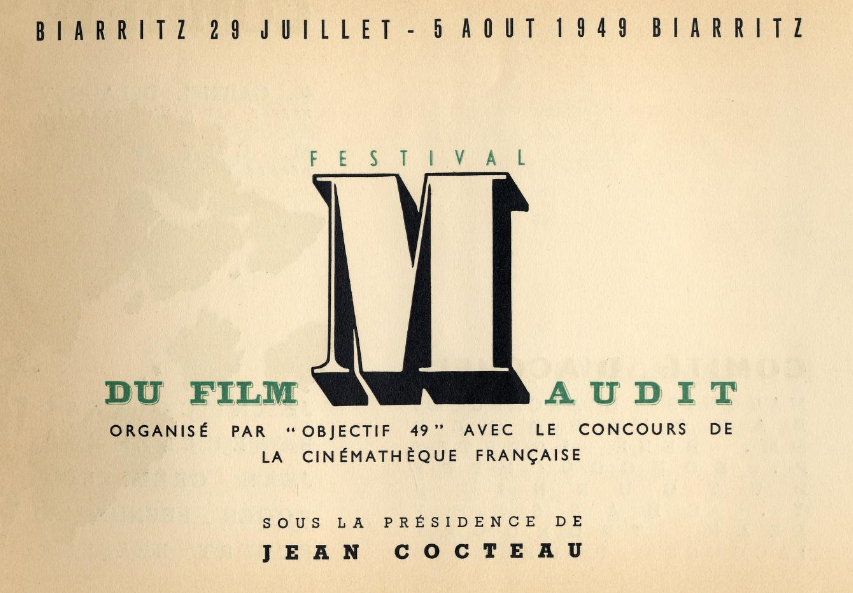
Festival du Film Maudit Programme
1949
Objectif 49
The hostility between the young and older cinephiles has to be understood as slightly ironic, as the festival was founded out of a very similar rift.
After the end of the Second World War, French film culture was massive; American films that had been banned during the Occupation flooded the system (to the outrage of many), admissions reached as high as 400 million a year, and there were over 150 clubs in the ciné-club movement, more than half of them in Paris, showing films more or less every week.
Alongside L’Écran français, born clandestinely during the Occupation, came La Revue du cinéma, revived in 1946 after closing in 1932. Even serious intellectual magazines like Jean-Paul Sartre’s Les Temps modernes and Esprit took cinema seriously; Esprit‘s regular film critics included André Bazin and Chris Marker. And so emerged a whole new generation of cinephiles.
But by 1948 a split had emerged among these cinéastes. L’Écran français, which had always been run by the Communists who founded it during the Occupation, became more hardline pro-Communist and anti-American after the end of the postwar Tripartisme coalition in 1947. Yet some critics liked American films and found the social realism of Louis Daquin and Georges Sadoul dreary. They had no natural home, and that is how their ciné-club, Objectif 49, was founded.
Accounts vary on who the founders were: Gourmelen suggests Cocteau, Orson Welles and Bazin at the Venice Film Festival in summer 1948. Mary Meerson claimed it was Henri Langlois’s idea. And Jean-Charles Tacchella claimed it was the organic outcome of many meetings between himself, Cocteau, Bazin, Claude Mauriac, Doniol-Valcroze, Alexandre Astruc and Pierre Kast at the Excelsior bar during the August 1948 Venice festival, where they decided to found a ciné-club aimed at “the films of tomorrow.” Tacchella says Cocteau suggested the idea, so they made him president.
Either way, it was agreed they would found a ciné-club based on a new way of seeing films. The club opened on 2 December 1948 at the Studio des Champs-Élysées with the first showing of Cocteau’s Les Parents terribles, which Cocteau then debated with the audience. This became the club’s format: a film, then a public debate, usually before a full house. The meetings continued until the club faded out in 1951.
The club had considerable prestige; regulars included Roger Leenhardt, Robert Bresson, René Clément, Jean Grémillon and Raymond Queneau. It was a very closed, influential and chic club, frequented by the editors and readers of the big Parisian intellectual reviews rather than the general public most ciné-clubs catered to.
Objectif 49 was known for showing contested films, its emblems being La Règle du jeu (1939) and The Magnificent Ambersons (1942), and Jean Vigo its martyr. It regularly showed new or unreleased films rather than the classics other clubs showed, plus misjudged films like Welles’s Macbeth. This planted the seed of the group’s maudit idea.
While Cocteau was club president, Bazin was the real master of ceremonies. Over the club’s three years, Rossellini, Welles, Grémillon, Renoir and Resnais all presented their films there.
Most of the screenings were held at the Broadway, run by Léonide Keigel, who became the club’s volunteer treasurer and, in 1951, the man behind the money at Cahiers du cinéma. The club also held a short American film noir season at the Pagode, which Andrew dates to late 1948 but Nowell-Smith to May 1949. Either way, this is where the club members first met the Left Bank teenagers and decided to push for something bigger.
The first public clash with L’Écran français came almost immediately, with Henri Jeanson attacking Objectif 49, Leenhardt’s Les Dernières Vacances and Bresson’s Les Dames du Bois de Boulogne. Bazin responded with “Découverte du cinéma: Défense de l’avant-garde” (L’Écran français, December 1948), where he redefined the avant-garde so that it covered Bresson, Leenhardt, Renoir and Welles.
The second public clash came over Alfred Hitchcock, who at that point was regarded as a craftsman, not an artist. Jean-Charles Tacchella and Roger Thérond, nicknamed “the Americans” for their Hollywood enthusiasm, published “Hitchcock se confie” (L’Écran français, 25 January 1949).
The article was a translation of, and commentary on, Hitchcock’s talk at the G.B. Theatre as printed in The Cine-Technician no. 14 (November–December 1948). The framing was pure provocation: it declared Hitchcock and Wyler the only Hollywood directors at full strength, praised Rope for its economy, and published Hitchcock’s joke “I have nothing left to do. Only to watch,” to which they added, “Bientôt, les vrais metteurs en scène ne viendront plus sur le plateau.” [Soon, real directors will no longer come to the set.]
Claude Vermorel responded with “Le cinéma, art clandestin” (L’Écran français, February 1949), claiming Hitchcock only produced “marchandises” and that the essence of cinema lay in the Lumières’ first three films.
Following this, Tacchella and Thérond surveyed French directors; respondents included Jean Delannoy, René Clément, Marcel L’Herbier, Jean Dréville, Maurice Tourneur and Henri Decoin. The question split them, with Delannoy coming down especially hard, attacking Hitchcock and Rope as cost-cutting dressed as art. (L’Écran français, 22 March 1949).
This culminated in “Le grand débat sur l’avant-garde au cinéma”, organised by L’Écran français on Thursday 10 March 1949, 8:45 p.m., at the Maison de la Pensée française, 2 rue de l’Élysée (announced in L’Écran français no. 191, 22 February 1949), where Bazin and Sadoul debated, with Jean Mitry, Alexandre Astruc, Louis Daquin and Roger Leenhardt intervening.
In response, Kast and Bazin wrote “Entretien sur une tour d’ivoire?” (L’Écran français, 29 March 1949), arguing that “whatever truly serves cinema will one day return to the public,” in reply to accusations that they were retreating into an elitist ivory tower. The coda is that Daquin’s mining film Le Point du jour was claimed as “une nouvelle avant-garde” in Les Lettres françaises (no. 260, 12 May 1949), repurposing Bazin’s concept.
The irony is that Bazin himself was deeply conflicted and not a great believer in Hitchcock, who had become the centre of the argument. In “Panoramique sur Hitchcock” (L’Écran français, 23 February 1950), he wrote: “Vive Hitchcock contre la plupart de ses détracteurs! Mais, entre nous, il nous a eus!” [“Long live Hitchcock against most of his detractors! But, between us, he fooled us!”]
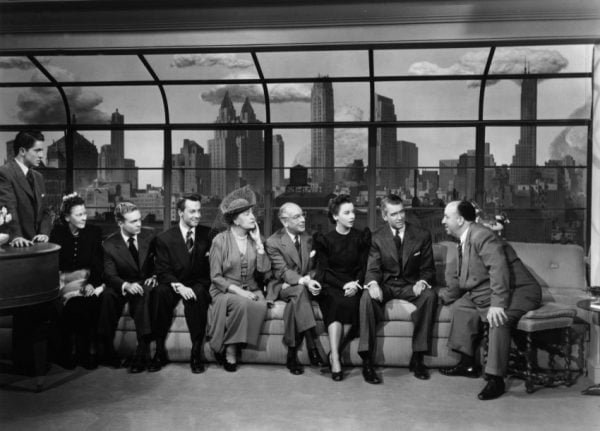
Hitchcock and the cast of Rope
1948
Inventing the Maudit
By spring 1949, Objectif 49 had been branded the elitist, formalist club by the Communist critics. In April 1949, Cocteau launched the Festival du Film Maudit with the explicit premise of choosing the films themselves: “Nous choisirons nous-mêmes nos films. Nous serons de parti pris.” This was a dig at the big international festivals, where national governments chose the entries, and a defence of films censored or held back by exhibitors’ demands. The term maudit was borrowed from Verlaine’s Les Poètes maudits.
Robert Bresson gave it a serious definition on the RTF on 26 April 1949, arguing that Objectif 49 wanted to reward, “alongside ‘commercial’ films, other films to which the cinema owes so much, I would even say everything,” and defending the inclusion of 16mm films at the festival “because the cinema is beholden to capital.”
The festival was planned in an office at Gallimard, 5 rue Sébastien-Bottin, with the whole circle involved. The dates were set for 29 July to 5 August, with a single prize of one million old francs for a non-commercial film. Announced star guests included Marlene Dietrich, Gérard Philipe and, “surtout”, Orson Welles.
At the time, most European film festivals took place at fashionable resorts, so Objectif 49 picked Biarritz, the city that had lost the 1939 “free-world” festival to Cannes. This made it, in Bazin’s phrase, the “ideal setting for the cinematic plot” (Le Parisien libéré, 30 July 1949). No financial records survive, but Bazin claimed its budget was about a tenth of a normal festival’s (Le Parisien libéré, 6 August 1949).
Biarritz agreed to host the festival thanks to pressure from Pierre d’Arcangues, president of the syndicat d’initiative and a friend of Cocteau, who became its main patron, though the municipality contributed little money. Ralph Glassner, a Scottish psychologist in attendance, wryly wrote that the festival’s “true purpose was tourist promotion.”
Tacchella remembered the selection of films as a casual affair. Once or twice a week through spring 1949 they met at the Madrigal, a café on the Champs-Élysées next to Keigel’s Broadway, suggesting films and then trying to find prints. Among those that fell through, for rights or timing, were several that time has since proved genuinely maudit:
- Chaplin’s Monsieur Verdoux, The Great Dictator and A Woman of Paris
- Grémillon’s Remorques
- Visconti’s La terra trema
- “Above all”, Stroheim’s Greed and Renoir’s La Règle du jeu
The Cinémathèque française supplied prints through its president, Jean Grémillon, and Bazin spent much of the year writing letters, sending programmes and chasing unknown films, including finding Norman McLaren and Michelangelo Antonioni.
The programme carried the festival’s ideas and is the best source for what “maudit” meant to Objectif 49. Designed by Jean Tronquet, it included texts from the club’s patrons and from poets like Baudelaire and Lautréamont, plus a comic litany by Queneau cursing libertines, prudes and the avant-garde. It ends “Maudits soient les films maudits” (“Cursed be cursed films”), a good epigraph for the festival as a whole.
Inside the booklet, Cocteau attacked a “non-thinking or wrong-thinking minority” that had decided it knew what the public wanted; Grémillon wrote that distributors wanted a perfectly neutral object; and Leenhardt attacked the spectator and the public’s refusal of ambiguity. The most important essay was Bazin’s “L’avant-garde nouvelle”, which argued that the avant-garde of 1928 failed because it didn’t care whether anyone followed, while Objectif 49’s avant-garde was made of films “in advance of the cinema.”
The festival’s title alarmed the authorities. Interior Minister Jules Moch first threatened censorship, then settled for sending an observer, while local papers reassured Biarritz that none of the films would be unsuitable for well-brought-up ladies (Le Républicain du Sud-Ouest).
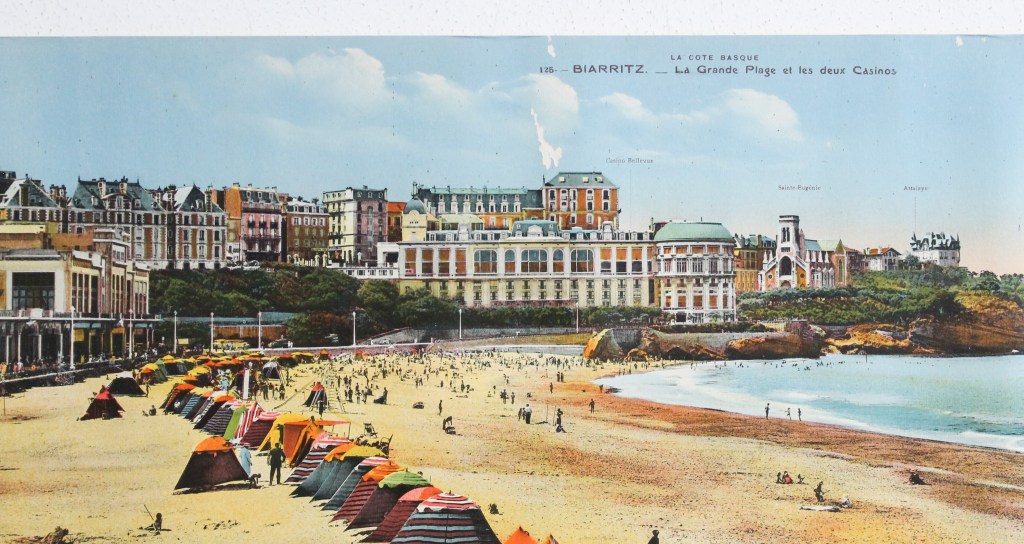
Biarritz Travel Poster
C. 1940s
First Days
The festival had promised a constellation of stars: Gérard Philipe, Marlene Dietrich, Laurence Olivier, Michèle Morgan, Maria Casarès, Orson Welles, Erich von Stroheim… They all cancelled. Instead it got actresses like Tilda Thamar, Cécile Sorel and Gabrielle Dorziat, a lower calibre than promised. Similarly, several prints had fallen through, so the film list had changed.
Who made up the jury is a bit ambiguous. Gourmelen says only that the jury was made up of Objectif 49 members, except for Jean George Auriol, and that Bresson and Langlois didn’t attend. However, Tacchella said Bresson and Leenhardt couldn’t come. I found three full line-ups:
- Roud: Langlois, Cocteau, Bresson, Clément, Astruc, Leenhardt, Grémillon, Auriol, Queneau, Claude Mauriac
- Cahoreau: Bresson, Clément, Langlois, Mauriac, Leenhardt, Astruc, Auriol, Queneau and Grémillon, with a separate committee of the prefect, the mayor and Welles
- Andrew: Cocteau, Bresson, Clément, Langlois, Mauriac, Queneau
Obviously, they can’t all be correct.
The festival opened on Friday 29 July at 9:30 p.m. to a full casino hall over which Cocteau presided, with Pagliero’s Rome, Free City as the opening film. This creates a small puzzle, as Truffaut’s postcard, dated 30 July, says the festival opens “tonight”. Ultimately, the opening night didn’t generate the publicity the organisers wanted.
Truffaut came because Bazin insisted he join him. He took the night train from the Gare d’Austerlitz on the evening of 29 July, travelling penniless, and on the morning of the 30th wrote a postcard to Robert Lachenay: “Trip dreadful, weather so-so… Cocteau has arrived. Photos and more photos, the beach is straight out of Jean Vigo… I’m almost broke. François Toréador.” Perhaps on the same train was Jean Douchet, who spent the night talking films with Éric Rohmer, then still Maurice Schérer.
Bazin, through Travail et Culture, had found the money to bring the young cinephiles down. Lydie Jeanbrau (who worked as Lydie Mahias, and married Jacques Doniol-Valcroze in 1950) was in charge of the young group: Truffaut, Rohmer, Douchet, Jean Boullet, Chris Marker, Charles Bitsch and “a British contingent consisting of Graham Greene and Lindsay Anderson.” Bazin himself arrived on the festival’s first day, the same day his son Florent was born; he had married Janine in May 1949.
Godard, despite many claims otherwise, was not at the festival. According to Antoine de Baecque he spent the summer in Switzerland, while Nowell-Smith places him at an art gallery in Mont-Riant. Either way, Charles Bitsch confirmed Godard didn’t attend.
On Saturday 30 July, the first morning screening was Vigo’s Zéro de conduite and L’Atalante. The organisers summoned journalists and photographers to the beach and held a press conference in dinner jackets, feet in the water. This became the official, often-circulated photograph of the festival. It was Cocteau’s idea: “Come, we will paddle in the water in front of the photographers.”
Despite Objectif 49’s nonconformist posture, it should be noted that the club took part in every society function in the region during the festival.
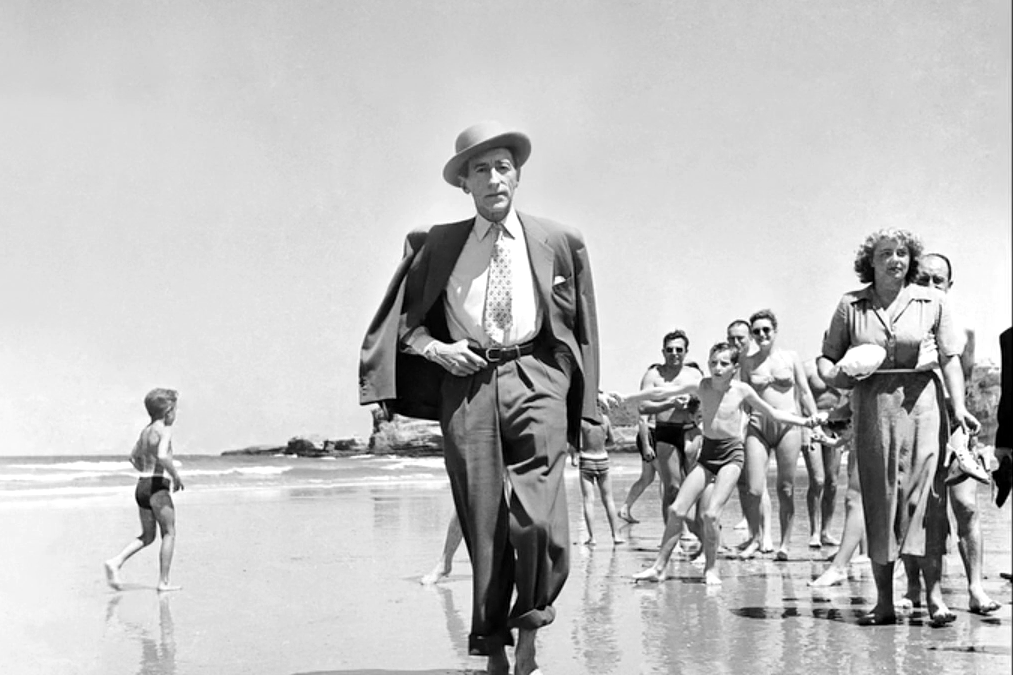
Jean Cocteau at the Beach
1949
The Week
Twenty features were shown in total across three categories. Amateur and experimental films, mostly shorts, were shown in the mornings; films maudits proper (films the critics regarded as good but the public had ignored) in the afternoons; and unreleased films, mostly foreign films whose distributors feared they would fail in France, in the evenings. Of the features, 11 were American, 4 French, 3 Italian and 2 German, while Britain sent a single documentary and the USSR, boycotting Western festivals, refused to take part.
But while the films were the festival’s cause, the real event was the debates. André Bazin ran an hour-long debate every afternoon at 3 p.m. in the casino on the previous day’s films. Jean-Pierre Vivet wrote that no festival regular could remember debates so heated; some lasted as long as the films (Combat, 6–7 August 1949). Bazin’s own summary in L’Écran français was that the essence of the festival had been in the hall, not on the screen (L’Écran français nos. 214–215, 8 and 15 August 1949).
The debates were lively: Grémillon defended Lumière d’été, and Cocteau held forth on the curse that had fallen on these films. Meanwhile, Louis Daquin and Alexandre Astruc came to blows.
Éric Rohmer, still signing as Schérer, organised screenings and introduced The Flame of New Orleans, Les Dames du Bois de Boulogne and Lumière d’été. Philippe d’Hugues’s notebook for 4 August captures him in action: a little stammering in the discussion on Bresson, brilliant and at ease presenting Clair. On a list of the twenty-four people d’Hugues noticed at the festival, he ranked this unknown sixth, behind Cocteau, Grémillon, Bazin, Bourgeois and Auriol, but ahead of Astruc, Mauriac and Clément.
The screenings themselves were a mixed bag: L’Atalante, Rome, Free City and Ride the Pink Horse were all applauded, but audiences were bored by Kuhle Wampe and Address Unknown, and The Southerner was even booed.
Similarly controversial were the experimental shorts, which Schérer felt undermined Objectif 49’s programme of not reviving the old avant-garde. Yet these films, by the likes of Oskar Fischinger, Norman McLaren, Len Lye, James Whitney and Kenneth Anger, have since come to define the festival’s experimental side; this was where Anger first found acclaim.
The big hit of the shorts was Jean Rouch‘s Initiation à la danse des possédés, which even Schérer praised. It was Rouch’s first colour short from Niger, its edit unfinished and with no soundtrack, shown only because Doniol-Valcroze insisted on bringing it. Rouch narrated it live from the hall, and the producer Pierre Braunberger, who was in the audience, met him there, beginning their long, fruitful relationship.
On 3–4 August, Astruc and Marc Doelnitz staged a show on Lac Mouriscot for the festival’s guests and local society: a sequence of film-inspired sketches with son et lumière. Its climax was a Nosferatu figure crossing the lake by boat to stage a kidnapping, to a soundtrack of screams, machine guns and cannon. Louis Chauvet called it a quarter of an hour of prefabricated terror (Le Figaro, 5 August 1949). Doniol-Valcroze noted that it lacked rehearsal.
The festival closed with Ossessione at midnight on Friday 5 August. The film had been unreleasable since it was made, because MGM held the rights to The Postman Always Rings Twice. The closing party was held the next evening at Arcangues, d’Arcangues’s village.
The festival’s only official prize, a million francs, went to Rouch. La Cinématographie française lists Mourning Becomes Electra as best unreleased film and its star Katina Paxinou as best actress, while Vittorio De Sica won best actor for Rome, Free City. Anger always said Cocteau gave Fireworks a prize for poetic film, but this may be an exaggeration by Anger; I found no first-hand proof confirming it.
Programme as published
| Day | 10 a.m. | Afternoon | Evening |
|---|---|---|---|
| Fri 29 Jul | — | — | Opening ceremony; Rome, Free City (Pagliero), 9:30 p.m. |
| Sat 30 Jul | Zéro de conduite, L’Atalante | The Long Voyage Home | Address Unknown (Maté) |
| Sun 31 Jul | Our Town (Wood) | Lumière d’été | The Southerner |
| Mon 1 Aug | Shorts: Bailly, Sarlié, McLaren | Kuhle Wampe | Ride the Pink Horse |
| Tue 2 Aug | Shorts: McLaren, Fischinger, Len Lye, Whitney, Anger’s Fireworks | Unter den Brücken (Käutner) | None but the Lonely Heart |
| Wed 3 Aug | Shorts: Livet, Zimbacca’s Square du Temple | Les Dames du Bois de Boulogne | Time in the Sun (Seton/Eisenstein) |
| Thu 4 Aug | Rouch, Initiation à la danse des possédés | The Flame of New Orleans (Clair) | Mourning Becomes Electra |
| Fri 5 Aug | The Forgotten Village | 1860 (Blasetti); The Shanghai Gesture | Ossessione, midnight |
The Two Biarritzes
The festival looks so interesting to our retrospective eyes for a simple reason: it was the first visible divide between the old vanguard and the coming one. The Objectif 49 names stayed at the Hôtel du Palais and went to the balls and the Nuit maudite. The press covered them largely because of who they were. Bazin wrote for Le Parisien libéré, Jean-Pierre Vivet for Combat and Claude Mauriac for Le Figaro littéraire.
There are two photographs, not reproduced here for rights reasons but accessible here [link to other source], which show Objectif 49 in all its splendour:
- One, on the beach, was Cocteau’s idea. It features Alexandre Astruc, André Bazin, Claude Mauriac, Mitsou Dabat, Lydie Mahias, Grisha Dabat, René Clément, Jean Grémillon, Raymond Queneau, Jacques Doniol-Valcroze, Éric Rohmer, Jean Cocteau, Léonide Keigel, Jean-Charles Tacchella, Jean Tronquet, Roger Thérond, France Roche, Pierre Kast, Jean-Pierre Vivet and Jacques Bourgeois. They wear dinner jackets with their feet in the water.
- The other, outside the casino, features Kast, Dabat, Doniol-Valcroze, Vivet, Bazin, Mauriac, Astruc, Cocteau, Grémillon, Jacques Bourgeois and one unidentified man.
These photos were taken because opening night had failed to generate publicity and local journalists were accusing the club of “licentious”, even “satanic”, motives, so they staged the beach photo shoot with every member.
An eagle-eyed reader might notice who is and isn’t among those photographed. Rohmer, notably, is in the picture, but none of the other future New Wave names are. This isn’t really a matter of age: Lydie Mahias, the chaperone of the younger cinephiles, was herself only twenty-one, and she is in it.
No: while the Objectif 49 types stayed at the Hôtel du Palais, the Parisian cinephiles slept in the dormitory of the town’s lycée alongside twenty English students. This is where Truffaut met his future accomplices: Rivette, Chabrol, Bitsch, Douchet and Philippe d’Hugues. Rohmer also slept there, feeling closer to these young cinephiles than to the Objectif 49 stars at the Palais.
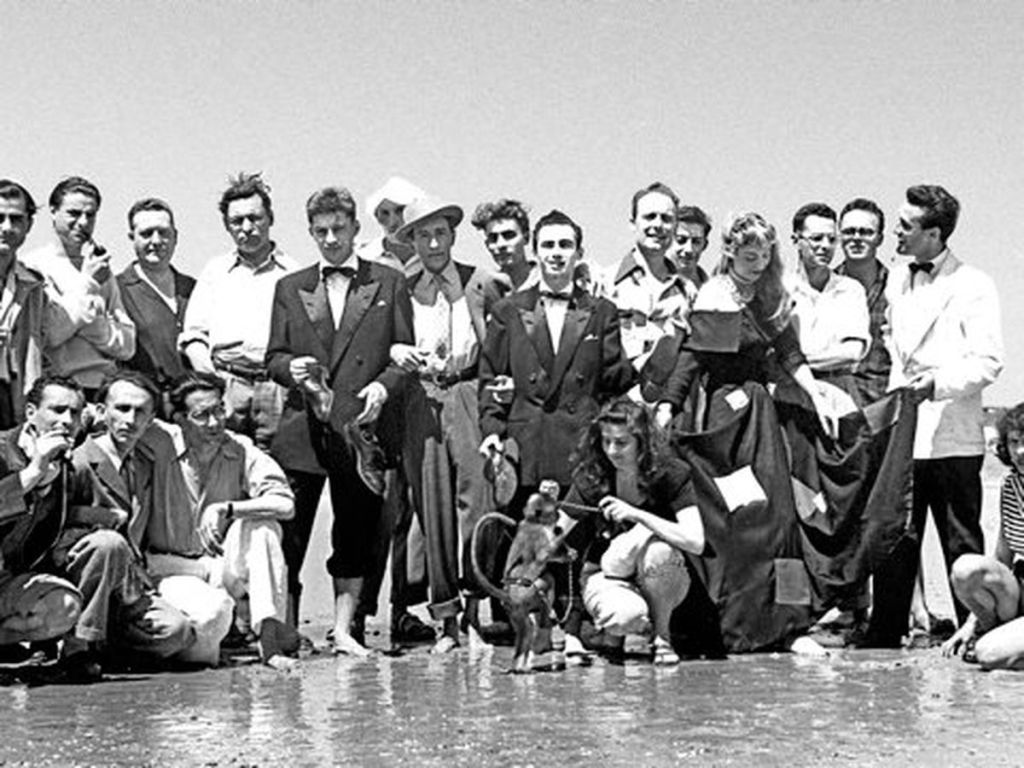
Objectif 49 at Festival du Film Maudit
1949
Festival Verdict and Impact
Critically, the festival was a success, though some found it too serious and too fond of obscure or over-aesthetic films. Georges Lerminier called it a veritable nascent academy of the seventh art (Témoignage chrétien, 12 August 1949). Henri Magnan in Le Figaro turned the festival’s premise back on it: the audience of a festival of cursed films ought to be shocked, and thinning it out would do no harm, even at the cost of a few small scandals (5 August 1949).
Denis Marion went further, arguing that the truly cursed films were the ones nobody had seen and sardonically accusing Cocteau of creating a flea market of cinema, collecting its leftovers, failures and unfinished works. Bresson, he argued, was cursed not because Les Dames failed commercially (millions saw it) but because he had not shot a film in five years. Marion proposed that real cursed cinema was unseen silents, forgotten one-offs such as Borzage’s Sur le velours, abandoned films such as Carné’s La Fleur de l’âge, and finally trailers, “so cursed that no one has ever cared about them” (France Illustration, 27 August 1949).
Still, the festival did what it set out to do. It caused a debate and questioned how success and failure were judged. The best line belongs to Bazin, on the applause for L’Atalante fifteen years after it failed: “Demain, le cinéaste maudit ne sera peut-être plus celui qui aura refusé de vendre son âme au diable.” [Tomorrow, the cursed filmmaker may no longer be the one who refused to sell his soul to the devil.] (L’Écran français nos. 214–215).
Rendez-vous Maudits
There was a second festival; how could there not be, after the first had been a success on its organisers’ own terms? But the ground had shifted beneath the elders’ feet.
La Revue du cinéma‘s final issue appeared in December 1949, when Gallimard decided to stop publishing it. The Revue had been the critical home of many non-Communist journalists opposed to L’Écran français, so Biarritz’s natural magazine was dead before the second festival even began. Worse, Jean George Auriol, the Revue‘s editor and a member of the Biarritz jury, was killed in a car accident on a road near Chartres on 2 April 1950.
There were many attempts to fill the gap. The most famous was La Gazette du cinéma, Éric Rohmer’s attempt to expand his ciné-club’s newsletter into a proper magazine, which ran from May to November 1950. There was also an Objectif 49 magazine, led by Roger Leenhardt at Cocteau’s request, which failed for lack of a publisher.
The second festival was held from 11 to 18 September 1950, free of Cannes’s shadow, as Cannes wasn’t held that year for budgetary reasons. It dropped the “Festival du Film Maudit” title for the more respectable “Rendez-vous de Biarritz”, and in doing so gave up the maudit cause the festival had been founded on. The line-up showed it too: instead of rehabilitating cursed films, it showed mostly unreleased contemporary ones.
Tacchella set out this line, declaring that Biarritz had chosen its era by honouring Edward Dmytryk, one of the jailed Hollywood Ten (L’Écran français no. 270, 11 September 1950). René Clément presided over the festival, and Doniol-Valcroze was the main organiser. The Marquis d’Arcangues opened it, and Clément gave an opening speech. There were no prizes.
Biarritz had been displeased with the previous year’s lack of stars, so this time it took little interest and put no money in, which made for a generally poorer event.
The two people who had given Biarritz its authority, Bazin and Cocteau, weren’t there either. Bazin was resting in a Pyrenees sanatorium with acute tuberculosis. Others, like Bresson, Leenhardt and Astruc, hadn’t bothered to come. There was no communal spirit, and the conversation between artist and audience that Bazin had led was missing. Jacqueline Michel wrote that the festival lacked warmth and atmosphere (Le Parisien libéré, 15 September 1950). The young cinephiles were there, though: Rivette, Chabrol, Douchet, Bitsch, Gruault, Truffaut and Godard. This is where Godard and Truffaut properly met.
The festival started flatly: the exhibitions on the Czech animator Jiří Trnka and on Grémillon’s unmade Le Printemps de la liberté were delayed from Monday to Thursday. The opening film, John Sturges’s The Capture, was not a hit with the press. Roger Désormière’s concert of film music, one of the festival’s unique attractions, was remembered with disappointment. Again, the stars stayed away. The few who came to the opening cocktail, Odette Joyeux, Juliette Gréco, Geneviève Page, Maurice Escande, Alexander Mackendrick and Simone Simon, were hardly glamorous draws in 1950.
There were no French features at the festival. Doniol-Valcroze blamed French producers, who he said preferred Venice or Belgium, yet none of Objectif 49’s own films was there either, such as Cocteau’s new Orphée. The only French films were shorts: Clément’s Arabie interdite (shot in Yemen in 1937), Resnais’s Guernica, and Grémillon and Kast’s Les Charmes de l’existence.
Many complained that the programme leaned too heavily on British films. Five were sent, including Hamer’s The Spider and the Fly, a revival of The 39 Steps and Mackendrick’s first film, Whisky Galore!.
The USSR was represented by Savchenko’s The Third Blow, Donskoi’s The Childhood of Maxim Gorky and shorts. The US sent five films, three of them unreleased, including Ray’s They Live by Night. Italy sent two, and Czechoslovakia one, Trnka’s The Emperor’s Nightingale.
Gourmelen reads this as a return to the “subject”, with social-problem films replacing the experimental spirit of 1949: Intruder in the Dust, Crossfire, Give Us This Day and They Live by Night, none of which fits the cursed-film label.
Yet there were successes. Nicholas Ray, Alexander Mackendrick, Alain Resnais and Michelangelo Antonioni all had early films shown here, and many films were heavily praised: Crossfire, Give Us This Day, The Emperor’s Nightingale, Arabie interdite, Guernica, Whisky Galore! and The Childhood of Maxim Gorky.
The big event was meant to be a stage version of Grémillon’s Le Printemps de la liberté, held on Sunday 17 September at the Casino Bellevue: an hour-long performance of the reworked script in a set by Léon Barsacq. It left the press disappointed and with little idea of what the film was meant to be.
Ultimately, the festival didn’t succeed. The first major crack was over Edward Dmytryk. On 15 September, Kast, Tacchella, Queneau, Grémillon and Clément signed a manifesto of support for him, from which Claude Mauriac publicly dissociated himself, leading the casino audience to boo him. For Mauriac, Dmytryk’s situation weighed little against the Soviet camp system (Le Figaro littéraire, 23 September 1950).
This exposed the festival’s own Cold War fault line. Many in the press, like Henri Magnan, felt the Soviet films could have been left out (Le Monde, 20 September 1950). The irony, of course, is that the whole cause would prove pointless: the following year, Dmytryk named twenty-six former associates to the House Un-American Activities Committee.
Perhaps the most important reaction was Jacques Rivette’s “Bilan pour Biarritz” in the fourth issue of La Gazette du cinéma. Rivette quoted the organisers’ promises back at them: Clément’s “intellectual complicity” and Doniol-Valcroze’s “violent love for the art of film”. He listed the club’s sins: character over actor, screenplay over action, découpage over mise en scène, abstraction over “a sum of details”.
He described the festival as a place of sparse screenings, huddles of eminences, closed cocktail circles and personalities enjoying “eight cheap days by the sea”. He apologised, sarcastically, for having “played the intruders”. Then came his verdict: Objectif had summoned them down there and failed to keep the appointment. He concluded: “Objectif détruit.”
Afterlife
There was no third Biarritz. Tacchella felt the Rendez-vous had lacked a soul, a goal and a theme (L’Écran français no. 272, 25 September 1950). Doniol-Valcroze was embarrassed and hurt by it. The festival died without a splash; Rivette’s verdict came true. La Gazette du cinéma had already ended in November 1950 (Francis Bouchet remembered the printer, who was owed money, telling them one day it was over, as suddenly as that), and Objectif 49 dispersed for good in 1951.
The story is slightly more complex than that, as this was an era of many small festivals competing with Cannes before it fully dominated. One, formed as a kind of counter-festival to Biarritz, was Henri Langlois’s Festival du Film de Demain, held in Antibes in September 1950.
In the end, the two generations of critics ended up under one roof. Léonide Keigel, the Broadway’s owner and Objectif 49’s treasurer, offered Doniol-Valcroze the money for a magazine, and the first Cahiers du cinéma appeared in April 1951 under Doniol-Valcroze, Bazin and Lo Duca. By the end of 1953, Godard, Rivette, Rohmer and Truffaut had all written for it, slowly supplanting the older generation of critics, leading to Truffaut’s “Une certaine tendance du cinéma français” (January 1954).
It is easy to make the romantic argument that the Festival du Film Maudit was the instigating factor of the early New Wave: the moment the young cinephiles developed their position against the cinéma de papa, the moment they resolved to kill their seniors. But this is something of an overstatement. Most of the young critics did meet there, and it may have helped forge their bonds, yet the link between Objectif 49 and Cahiers was indirect. Cahiers was never a faithful continuation of the maudit project, and its founders were not the seniors the younger cinephiles particularly resented.
Yet the festival did cast a shadow over the coming movement. The auteurs favoured by the New Wave were largely Objectif 49’s patrons and favourites, and Cahiers did, eventually, grow out of its circle. The Festival du Film Maudit set out to rescue cursed films and, in a way, cursed its own generation of critics and filmmakers, Leenhardt, Grémillon and Clément among them, by bringing together the young critics who would become their sharpest opponents.
Sources
- 1895, revue d’histoire du cinéma, n° 29, Arnaud Gourmelen, 1999
- Interview with Charles Bitsch, Senses of Cinema, Sally Shatto, 2008
- Godard, Antoine de Baecque, 2010
- Truffaut: A Biography, Antoine de Baecque and Serge Toubiana, 1996
- François Truffaut: 1932-1984, Gilles Cahoreau, 1989
- Le Temps accompli, Claude Mauriac, 1991
- A Passion for Films: Henri Langlois and the Cinematheque Francaise, Richard Roud, 1983
- Cinegrafie 14, Jean-Charles Tacchella, 2001
- Andre Bazin, Dudley Andrew, 1983
- Cahiers du Cinéma, n° 100, Jacques Doniol-Valcroze, 1959
- Making Waves: New Cinemas of the 1960s, Geoffrey Nowell-Smith, 2008
- Cinéma et musée: nouvelles temporalités, Perspective, Erik Bullot, 2011
- Cours, camarade… La séance a commencé, L’homme & la société, Laurent Chollet, 2001
- Les Années Éblouissantes : Le cinéma qu’on aime, 1945–1952, Jean-Charles Tacchella, 1988
L’Avant-Garde au Cinéma, François Albera, 2005- French Cinema, Charles Drazin, 2005
- Bresson on Bresson: Interviews 1943-1983, Robert Bresson, 2016
- The Ralph Glassner Omnibus, Ralph Glassner, 1999
- Festival du Film Maudit Programme, Objectif 49, 1949
- Objectif 49: Cocteau et la nouvelle avant-garde, Frédéric Gimello-Mesplomb, 2014
- Correspondence, Maria Casares and Albert Camus, 2017
- Histoire d’une revue, Vol 1, Antoine de Baecque, 1991
- Eric Rohmer: A Biography, Antoine de Baecque and Noël Herpe, 2014
- Jean Renoir, cinéaste, Celia Bertin, 2005
- Les Temps Modernes, 1949-10: Vol 5, Iss 48, Maurice Scherer, 1949
- Le Temps Immobile, Claude Mauriac, 1970
- Gazette du Cinéma No 4, Jacques Rivette, 1949


Leave a Reply