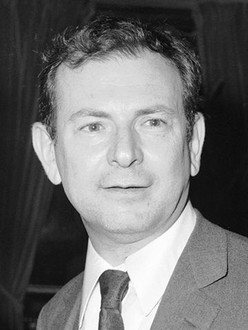
LIVED
6 November 1925, Răstolița, Romania – 26 August 1996, Paris
Jean Aurel was born Aurel Kupferman, a Jewish boy from a Transylvanian village who grew up in Bucharest, lived through the Iron Guard pogrom and fought with Tito’s partisans before he was twenty. In Paris he made himself into someone else: a Parisian-born critic and director who ran the cinema page of Arts, gave François Truffaut his platform, and stayed for thirty years the first person Truffaut showed his films to.
His own career was one of lurches. His first feature was taken from him after a few days of shooting, and the row that followed became the trial of the New Wave. With his friend Jacques Laurent, a writer of the right, he made two archive histories of France at war that were among the most discussed documentaries of the 1960s, then two adaptations of Stendhal, then comedies for Brigitte Bardot and Jean Yanne. His last film was a history of Stalin, praised in the anarchist press. He is remembered, when at all, as a footnote in other men’s lives.
SIMILAR FILMMAKERS
Claude de Givray
Frederic Rossif
François Truffaut
Jacques Doniol-Valcroze
Michel Deville
Philippe de Broca
START WITH
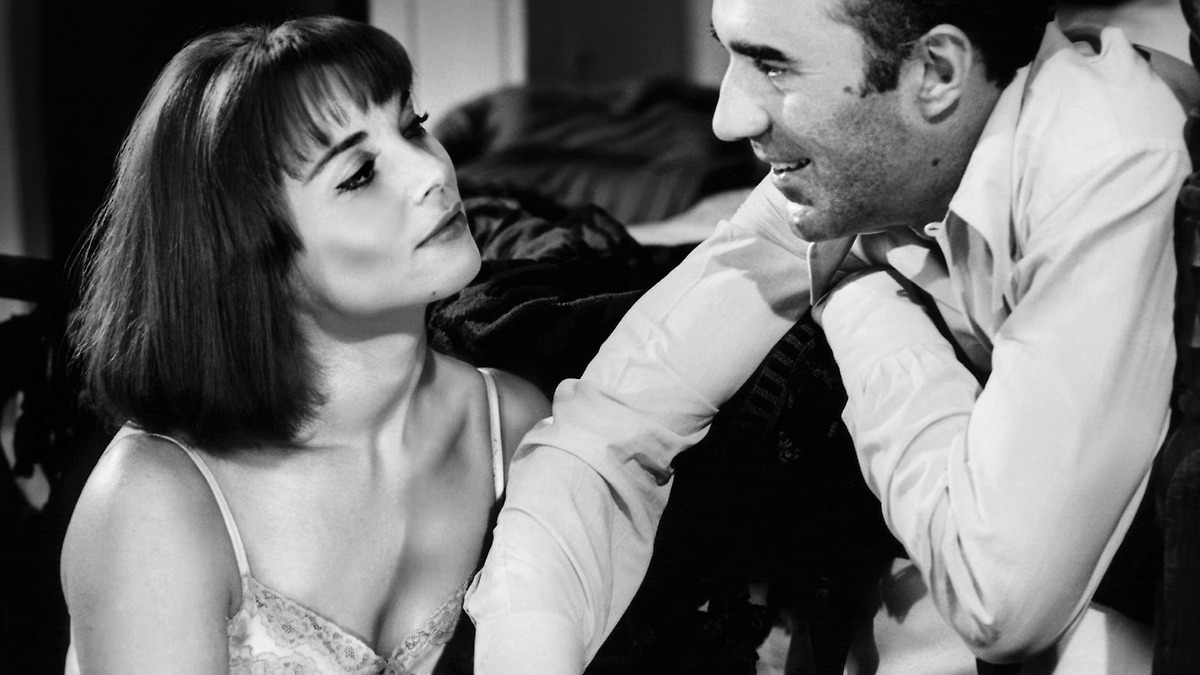
De l’amour (1964)
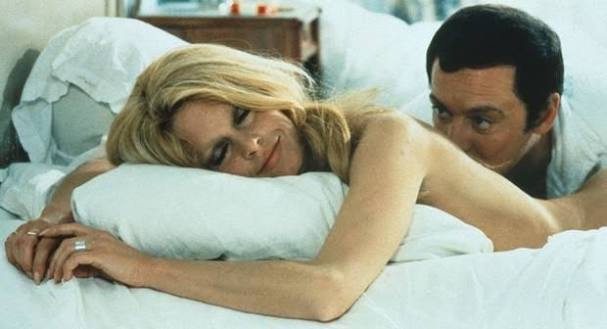
Les Femmes (1969)
Biography
1. Bucharest · 2. Paris and the short films · 3. Arts · 4. La Bride sur le cou · 5. Truffaut’s first viewer · 6. The war films · 7. Stendhal · 8. Bardot and Yanne · 9. Staline
1. Bucharest, 1925–1945
Aurel Kupferman was born on 6 November 1925 in Răstolița, a village in Transylvania (not in Paris, as he later told Who’s Who). His parents were Jews from Yugoslavia. His father, Beno, was born in Senta and grew up in Budapest; his mother, Blanka Klein, came from Kula and grew up in Croatia. They married in Požega in 1924, and Beno was sent to Romania as the representative of a Swiss timber firm, buying up wood and building factories. A sister, Marta, was born in Răstolița in 1928. The family followed the work from Brașov to Târgoviște to Moroeni, always meaning to go home to Yugoslavia, until in 1935 they settled in Bucharest so the children could go to school.
Aurel went to the Lycée français, and when his father was sent to build factories in southern Moldavia in 1938, he stayed on as a boarder. From 1940 the Romanian state expelled Jewish pupils from its schools, and the Lycée français, with the backing of the French minister Jacques Truelle, was the only non-Jewish school in Bucharest that kept taking them. At a June prize-giving, shortly before Truelle left Romania for good, the minister handed his own prize to Kupferman. An informer for the Romanian secret police was in the hall, and reported that when asked why he had honoured a Jew, Truelle answered that the Jews were at once the most intelligent and the most reviled of peoples.
Aurel and Marta lived through the Iron Guard’s pogrom in Bucharest in January 1941, and through the Allied bombing of the city in the spring and summer of 1944. The Swiss firm protected the family, though under the race laws Beno could no longer sign his own business documents. His mother’s family in Croatia did not survive the war; most of them were murdered at Jasenovac. After the Red Army took Bucharest in August 1944, Aurel, eighteen, left to join Tito’s partisans in Yugoslavia. He came back six months later, and then left again, for Paris. His parents and sister, finding life under the new communist regime unbearable, emigrated to Israel in 1949.
2. Paris and the short films, 1945–1953
In Paris, he studied at IDHEC, the national film school, and at the Faculté des lettres, and adopted Jean Aurel as his first name, turning it into a surname. The version of his life he later gave Who’s Who was a French one: born in Paris, the son of “Benjamin Aurel, industriel” and a mother née Blanche Moranger, educated at French lycées in Athens and Bucharest.
From 1948 he made short films on painters for Anatole Dauman’s Argos Films: Joan Miró (1948); Les Fêtes galantes (1950), on Watteau, with a text by Georges Ribemont-Dessaignes spoken by Gérard Philipe, which won the grand prize at the Rio de Janeiro festival; L’Affaire Manet (1951), written by Emmanuel Berl and spoken by François Périer; and Le Cœur d’amour épris du roi René and Les Aventures extraordinaires de Jules Verne (1952). He worked as an assistant, wrote essays, and began selling scripts.
3. Arts, 1953–1960
In 1953, Jacques Laurent, rich from the Caroline chérie novels he wrote as Cecil Saint-Laurent, founded La Parisienne and then bought the weekly Arts, which he wanted to turn into “a paper of moods and prejudices” written by the best pens of the literary right. He gave the cinema page to his friend Aurel, who in turn hired Truffaut to write for them. Together they invented the paper’s star ratings and its one-line verdicts, and were soon, in Truffaut’s words, crushed under the work. On 17 March 1954, Aurel ran a full page, “Où en est le cinéma français ?”, accusing the screenwriters Aurenche and Bost of exploiting a formula and leading French cinema into its darkest period: Truffaut’s argument, given the authority of the section’s editor. In July 1955, Laurent and Aurel commissioned Truffaut’s “Les sept péchés capitaux de la critique”.
Alongside the page, Aurel was a working screenwriter in every genre the industry had: the melodrama Club de femmes (1956), the Bardot comedy Une Parisienne (1957) for Michel Boisrond, co-written with Annette Wademant, Darry Cowl’s farce Le Triporteur (1957), René Clair‘s Porte des Lilas (1957) and Jacques Becker‘s Le Trou (1960). Truffaut later said that, like Becker, Aurel was a fanatic for visual clarity.
4. La Bride sur le cou, 1960–1962
His first feature came out of Laurent’s circle. In the spring of 1960, at La Madrague, Aurel and Laurent were working on a film with Bardot’s husband, Jacques Charrier, who was to produce and star; Bardot remembered three men drinking pastis from eleven in the morning, and herself nodding along. By the autumn the project had become La Bride sur le cou, a comedy from Aurel’s idea, produced by Francis Cosne and Jacques Roitfeld, with Bardot as star and co-producer. She had just made La Vérité with Clouzot and was emerging from a breakdown.
Shooting began at Billancourt at the end of November 1960, and within days it had gone wrong. Bardot found Aurel hesitant and pleased with himself, laughing at rushes she thought worthless. She told the producers she wouldn’t continue the film with Aurel; the producers tried to get Michel Boisrond and Claude Sautet to take over, but both refused. Roger Vadim, her first husband, accepted; initially, this was portrayed as a mutual agreement. A signed compromise credited Aurel with having conceived the film and Vadim with supervising it; they even sat for press together, but soon Aurel realised he’d been taken in.
Truffaut made it a cause. On 22 December, in France Observateur, he wrote that Vadim was now one of those people in cinema “capable of anything”. In January 1961, twenty-seven directors, from Cocteau, Duvivier and Delannoy to Resnais, Godard and Truffaut, signed a manifesto holding that no director could be removed from a film already shooting without his consent. Louis Malle denied having signed; Astruc and Autant-Lara refused. Vadim sued Truffaut for defamation, and on 29 January 1962 the “procès de la Nouvelle Vague” came before the 17th chambre correctionnelle, with Bardot in the witness box and Godard thrown out for shouting at Malle. Truffaut was fined 1,000 francs and ordered to pay Vadim one franc in damages. Aurel, who had brought and won a suit of his own, wrote offering to share the costs, and wanted Truffaut to appeal on principle. Truffaut let it drop.
5. Truffaut’s first viewer, 1961–1984
From Jules et Jim on, Truffaut never finished cutting a film without Aurel, which, he said, amazed people. Aurel read every draft of every script and saw every first assembly, and sat with Claude de Givray, Florence Malraux and Jacques Rivette on the informal committee that watched Truffaut’s films at each stage of the edit. Truffaut called his critical mind phenomenal. Aurel’s own rule was that finding what was wrong was not enough; you had to propose something that worked.
On 2 June 1966 he flew to London to see Fahrenheit 451. He liked it, but thought it started too late, with Montag reading his first book only at the end of the fourth reel. The next morning he watched the first four reels again and proposed swapping two long scenes so that Clarisse appears before Linda, which, as Truffaut noted happily, put the film back in the order of Bradbury’s novel. Truffaut adopted it on the spot. On La Nuit américaine Aurel pushed him to make the director the star of the film. He co-wrote L’Amour en fuite (1979), La Femme d’à côté (1981) and Vivement dimanche ! (1983), on which Truffaut gave him one per cent; his last notes, written while it was shooting, were about Trintignant’s misogyny.
He did the same work for others. In 1963, on Joris Ivens’s advice, he edited Marceline Loridan and Jean-Pierre Sergent’s Algérie année zéro, a film banned in France, and found its rhythm.
6. The war films, 1963–1964
With Laurent writing the commentary and his own company, Zodiac Films, producing, Aurel made 14-18 (1963), an archive history of the Great War, with the historian Raoul Girardet as uncredited adviser. It was a success with critics and audiences alike, an unexpected one for Laurent, an OAS sympathiser and a writer of frivolous best-sellers. Marc Ferro, commissioned at the same time to make the official television history of the war, used it as the model not to follow: a writer’s film, he thought, a poem about the soldier rather than history.
La Bataille de France followed in June 1964, shown in Cannes on the fringes of the festival to a rowdy press conference. Aurel built it as a classical tragedy in five acts, in which the actors do not know what the audience knows: the mobilisation of September 1938, Munich, Hitler entering Prague, the Phoney War, and the German offensive from 10 May 1940 to Dunkirk, where the film stops, on 4 June. He and Laurent had cross-checked Allied and Axis footage against written testimony, and he argued that newsreels showed what historians could not: at Munich, Daladier bitter and Chamberlain beaming; at the Gare de l’Est, reservists of 1938 who had plainly stopped believing what they were told. Stopping before 18 June meant leaving out de Gaulle, and in the France of 1964 that was unforgivable. François Mauriac attacked the film, Laurent attacked Mauriac, and the quarrel ended with Laurent in court and convicted.
Around this time an American friend, the journalist Thomas B. Morgan, described Aurel as a gangling, enthusiastic bachelor with “an anarchist’s heart dominated by a conservative’s brain”, too much taste to be held by any label, who lectured him over a pike dinner on America’s lack of strategy and told him the French did not really like anybody but the French.
7. Stendhal, 1964–1968
In 1964, Aurel suggested to Laurent that they film Stendhal’s essay De l’amour, and they were surprised how easily its theories of crystallisation, jealousy and fiasco turned into people. Set in modern Paris, with Michel Piccoli, Elsa Martinelli, Joanna Shimkus, Philippe Avron and Anna Karina, it opened on 29 December 1964. Michel Cournot wrote that it was not a transplanting of Stendhal but a film by Stendhal. It is his best film.
Lamiel, from Stendhal’s unfinished novel, had been a project for Chabrol and Belmondo at Films Ariane until Jean Aurenche, the screenwriter Aurel had attacked in Arts thirteen years earlier, delivered a script nobody liked. Georges de Beauregard took it on as an expensive costume picture. In November 1966, Aurel asked to test Anne Wiazemsky for the lead; Godard refused on her behalf without telling her, and the part went to Karina. Shooting began in March 1967, in a mansion on the rue Barbet-de-Jouy, with Jean-Claude Brialy. Aurel still wanted Wiazemsky, and Godard let her play a few seconds as “the most beautiful woman in Paris” in exchange for being allowed onto the set at the Théâtre Montpensier to film Jean-Pierre Léaud as Saint-Just for La Chinoise. At a private screening that July, Cournot laughed all the way through. Aurel apologised to Wiazemsky for the lighting on her shot, which he had not been able to afford to redo.
Manon 70 (1968), a modern Manon Lescaut with Catherine Deneuve and Sami Frey, failed. Deneuve, who had taken the part because of De l’amour, took her share of the blame: neither of them, she said, had been at their best. After May 68, Aurel’s partnership with Laurent cost him most of his old friends. Karina and Truffaut were the exceptions.
8. Bardot and Yanne, 1969–1974
Nine years after La Bride sur le cou, Bardot agreed to make Les Femmes (1969) for him, a small-budget comedy from a Laurent story, shot on location, with Maurice Ronet as a blocked writer and Bardot as the typist who unblocks him. Midway through, her lover walked out on her, she stopped coming to work, and the production was shut down on an insurance claim. In her memoirs, she called Aurel talentless.
Êtes-vous fiancée à un marin grec ou à un pilote de ligne ? (1970), from Henriette Jelinek’s novel La Marche du fou, was his first film without Laurent. Jean Yanne starred, with Francis Blanche, Françoise Fabian and Nicole Calfan, and improvised his dialogue on set; he spent the waits watching Aurel, and directed his own first film two years later. Comme un pot de fraises (1974), written with Gérard Sire, failed, and Aurel went back to writing. In 1973 he played a small part, the hero’s colleague, in Karina’s first film as director, Vivre ensemble.
9. Staline, 1975–1996
Most of what he planned in these years was never made: a new Stendhal, a modern Othello with a Desdemona much less innocent than the real one, and La Fille sur téléphone, which Truffaut was still trying to help him with in 1983. He wrote for Truffaut, and for Christine Carrière’s Rosine (1984). His last film came through Gérard Lebovici, the producer and publisher whose house, Champ Libre, had reissued Boris Souvarine’s 1935 Staline, the first great history of Stalinism, written by a founder of the French Communist Party. Lebovici commissioned Aurel to make an archive film from it, and when Lebovici was murdered in March 1984 his widow and colleagues saw the film through.
Staline came out in March 1985. It opens on the Wehrmacht and the Red Army fraternising in Poland in 1939 and ends on the dictator toasted by Churchill and Roosevelt. Le Matin sold it as a horror film, Le Monde found it a caricature, and Le Monde libertaire, the paper of the Fédération anarchiste, put it on its front page as a film against forgetting and lies. With 14-18 and La Bataille de France it completed a history of the century’s three catastrophes, the last two of which had passed through Bucharest while he was there.
In late August 1996 Laurent rang him and arranged to visit him the next day at the Hôpital Cochin. That night Aurel died in his sleep. He was seventy. Libération‘s obituary called 14-18 his first feature and left out La Bride sur le cou altogether.
Sources
Jean Aurel in his own words
- Letters to François Truffaut, 30 March 1962 and 19 November 1982, in François Truffaut, Correspondance avec des cinéastes (2025)
- Television interview with Roger Vadim, 9 December 1960 (INA)
- Interview on La Bataille de France, Cannes, May 1964
- Quoted in Bernard Trémège, Le Livre du scénario
Memoirs and firsthand accounts
- Anne Gillain (ed.), Truffaut on Cinema (Indiana University Press, 2017)
- François Truffaut, journal of Fahrenheit 451, as reproduced in Jerry Weist, Bradbury: An Illustrated Life (2002)
- Jacques Laurent, Stendhal comme Stendhal, ou le mensonge ambigu (1984)
- Jacques Laurent, Moments particuliers (1997)
- Brigitte Bardot, Initiales B.B. (1996)
- Roger Vadim, D’une étoile l’autre (1987)
- Annette Stroyberg, Les Liaisons scandaleuses
- Marcel Ophuls, Mémoires d’un fils à papa
- Anne Wiazemsky, Une année studieuse (2012)
- Thomas B. Morgan, Among the Anti-Americans (1967)
- Marc Ferro, interview, in De la BDIC à Histoire parallèle (2008)
- Catherine Deneuve, interviews in Cinéma 69 and Cinémonde (1970)
- Ginette Billard, interview with Georges de Beauregard, Film Quarterly
Studies
- Antoine de Baecque, La Cinéphilie (Fayard, 2003)
- Antoine de Baecque, Godard (Grasset, 2010)
- Antoine de Baecque, Chabrol
- Antoine de Baecque and Noël Herpe, Éric Rohmer: A Biography
- Bernard Bastide (ed.), François Truffaut, Chroniques d’Arts-Spectacles 1954–1958
- Marc Dambre, Génération Hussards
- Catherine Rihoit, Brigitte Bardot, un mythe français (1987)
- Carol Iancu, Alexandre Safran. Une vie de combat, un faisceau de lumière (Université Paul Valéry, 2007), as cited in 75 de ani de la Holocaust: evreii din Europa în timpul celui de-al Doilea Război Mondial
- Jean Yanne, l’esprit libre
- Armand Le Guern, Une âme damnée, Paul Gégauff (2012)
Period criticism and press
- “L’affaire Aurel-Vadim”, L’Express, 19 January 1961
- Louis Marcorelles, “Paris Notes”, Sight and Sound, Spring 1961
- El Adelantado (Segovia), no. 20981, June 1969
- Alexandre Skirda, “« Staline » livre et film”, Le Monde libertaire no. 572, 25 April 1985
- “Mort du réalisateur Jean Aurel”, Libération, 27 August 1996
Reference and records
- INSEE, Fichier des personnes décédées, 1996: Kupferman, Aurel, Paris 14e, act no. 1913
- United States Holocaust Memorial Museum, Photo Archives, Kupfermann family photographs, biography of Marta Kupfermann Elkana
- Who’s Who in France, 1973, 1977, 1984–85 and 1992–93
- Noël Simsolo, Dictionnaire de la Nouvelle Vague (Flammarion, 2013)
Filmography
| Year | Title | English title | Length |
|---|---|---|---|
| 1948 | Joan Miró | Short | |
| 1950 | Les Fêtes galantes | Short | |
| 1951 | L’Affaire Manet | Short | |
| 1952 | Le Cœur d’amour épris du roi René | Short | |
| 1952 | Les Aventures extraordinaires de Jules Verne | Short | |
| 1961 | La Bride sur le cou (replaced by Roger Vadim) | Please, Not Now! | Feature |
| 1963 | 14-18 | Documentary | |
| 1964 | La Bataille de France | Documentary | |
| 1964 | De l’amour | Feature | |
| 1967 | Lamiel | Feature | |
| 1968 | Manon 70 | Feature | |
| 1969 | Les Femmes | Feature | |
| 1970 | Êtes-vous fiancée à un marin grec ou à un pilote de ligne ? | Feature | |
| 1974 | Comme un pot de fraises | Feature | |
| 1985 | Staline | Documentary |

