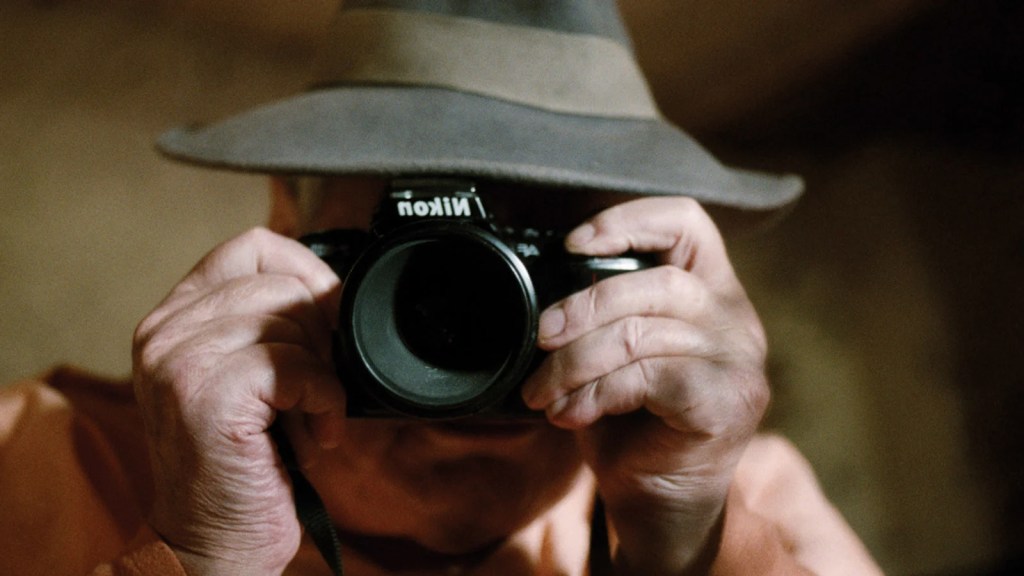
Jean-Daniel Pollet’s filmography barely looks like the work of one person. He’s associated with two completely separate approaches to filmmaking: melancholic burlesque comedies on one hand, poetic films built from literary texts on the other — and he never really chose between them, alternating for decades as if running two separate careers in parallel. Born into a haut bourgeois family, he studied political science in 1950s Paris, where he fell in with both the Cahiers du cinéma crowd and the avant-garde literary circle around the journal Tel Quel. He’d balance between both groups awkwardly, fitting into neither.
The split in his work appeared almost immediately. His tender, lowbrow comedies found their soul in actor Claude Melki, treated across several films as a kind of sad-sack alter ego. At the same time, Pollet was developing a wholly different ambition: to find new ways of presenting images steeped in the literary and lyrical qualities of poetry. That ambition produced Méditerranée (1963), assembled from a four-month road trip from Italy to Greece undertaken with his then-collaborator, future German New Wave director Volker Schlöndorff. Pollet filmed only one thing per shot, treating the footage like words or signs once it reached the editing room: “I wanted to maintain the free presence of things,” he said. Watching it while preparing Contempt, Godard described its “smooth, round shots abandoned on the screen like a pebble on the shore.”
Greece, and the idea of ruin, never really left him. He returned to the country repeatedly across his career, making shorts and features there, obsessively reinserting pieces of Méditerranée into later work as though the original film still had something more to say. His own explanation for the divide in his work was characteristically blunt: “It is easier for me to film things than to film people.” That preference for objects, ruins, and landscape over psychology runs through everything from his Mediterranean essay films to L’Ordre (1973), his documentary on a Greek leper colony.
A 1989 train accident left Pollet largely paralysed for the rest of his life, and his filmmaking narrowed accordingly. His final film, Jour après jour, was shot entirely from his home in Provence, a quiet record of his garden across the seasons, finished by his partner Sandra Paugam after he died in 2004. It’s a small, late coda to a career that spent forty years refusing to be one thing. For that reason, he remains one of the New Wave’s least classifiable names.
Jean-Daniel Pollet (1936 – 2004)
- 1958 – Pourvu qu’on ait l’ivresse…
- 1960 – Line of Sight
- 1961 – Gala
- 1963 – Méditerranée
- 1964 – Bassae
- 1965 – Une balle au cœur
- 1966 – Les Morutiers
- 1966 – Le Horla
- 1967 – Tu imagines Robinson
- 1970 – Le Maître du temps
- 1971 – Le Sang
- 1971 – L’Amour c’est gai, l’amour c’est triste
- 1973 – L’Ordre
- 1976 – L’Acrobate
- 1978 – Pour mémoire (La Forge)
- 1986: Au Père-Lachaise
- 1988: Contretemps
- 1991 – Trois jours en Grèce
- 1994 – Dieu sait quoi
- 2001 – Ceux d’en face
- A Career Split Down the Middle: Pollet never picked a lane. One half of his filmography is melancholy popular comedy, built around actor Claude Melki as a kind of French Buster Keaton: Pourvu qu’on ait l’ivresse…, L’Acrobate. The other half is severe, non-narrative cine-poetry: Méditerranée, Dieu sait quoi. Most directors smooth that contradiction out over a career; Pollet kept both running at once, decade after decade, as though refusing to choose was the whole point.
- The Camera as Measuring Instrument: In the art films, Pollet’s camera doesn’t wander so much as calculate. Shots are stable, framed with a deliberate margin of empty space, and tracking movements scan a landscape with an almost mathematical evenness. The distance is the design: it keeps the audience from settling into a character’s feelings, holding everything (ruins, bodies, sea) at the same cool remove.
- The Same Image, Returned To: Linear story was never really the engine in Pollet’s formal work; repetition was. A single tracking shot, or the structure of an entire film, will circle back to the same temple, the same ruin, the same fragment of footage. Méditerranée‘s images are reused this way both within the film and, later, across his career, as he kept reinserting pieces of it into new work. The effect collapses time rather than advancing it, trapping the viewer in something closer to a loop of memory than a sequence of events.
- Text Against Image, Not Text Explaining Image: Pollet built much of his career on collaboration with writers — Philippe Sollers, Jean Thibaudeau, Francis Ponge, among them, and the voice-overs they gave him were never there to clarify what’s on screen. They run alongside the images as a separate, often disorienting current, so that meaning has to be assembled by the viewer rather than handed over. It’s the nouveau roman’s logic transplanted into film: the text resists the picture instead of serving it.
- People as Visitors in Someone Else’s Ruin: Whether he was filming Greek temples or, in L’Ordre, a leper colony, Pollet kept returning to the same condition: history and decay pressing down on a present that can’t quite hold its own ground. He once said it was simply easier for him to film things than people, and the films bear that out. Human figures drift through these heavy, time-soaked spaces as alienated presences rather than as the emotional centre of anything, memory and the present sitting on equal footing throughout.
- Alain Resnais
- Boris Lehman
- Chris Marker
- Jean-Luc Godard
- Jean-Marie Straub & Daniele Huillet
- Jean Rouch
- José Luis Guerin
- Marcel Hanoun
- Marguerite Duras
- Volker Schlöndorff
Biography
Coming soon

