Alexandre Astruc published “Naissance d’une nouvelle avant-garde : la caméra-stylo” in L’Écran français (no. 144) on 30 March 1948, and its influence runs through the New Wave and well beyond. Raymond Queneau reportedly told him when it came out: “Alexandre, you don’t have to do anything else; you have entered posterity.”
It would be four more years before he released his first proper film, Le Rideau cramoisi (1952), starring Jean-Claude Pascal and Anouk Aimée. But his filmography lists two earlier shorts. One is the barely known Aller et retour (1948). The other, featuring everyone from Juliette Gréco to Jean Cocteau, is Ulysse ou les Mauvaises Rencontres (1948), not to be confused with his first feature, Les Mauvaises Rencontres (1955).
Alexandre Astruc: Critic, Welles, and Tabou
Astruc got his break as literary critic for the journal Poésie in 1943. After the Liberation, he moved to Paris, working at Franc-Tireur and then Combat, while also writing for Spectateur, L’Écran français and France Dimanche on the side. For a while he belonged to the Saint-Benoît Communist cell alongside Marguerite Duras, until he seemingly decided he needed no heroes except Orson Welles.
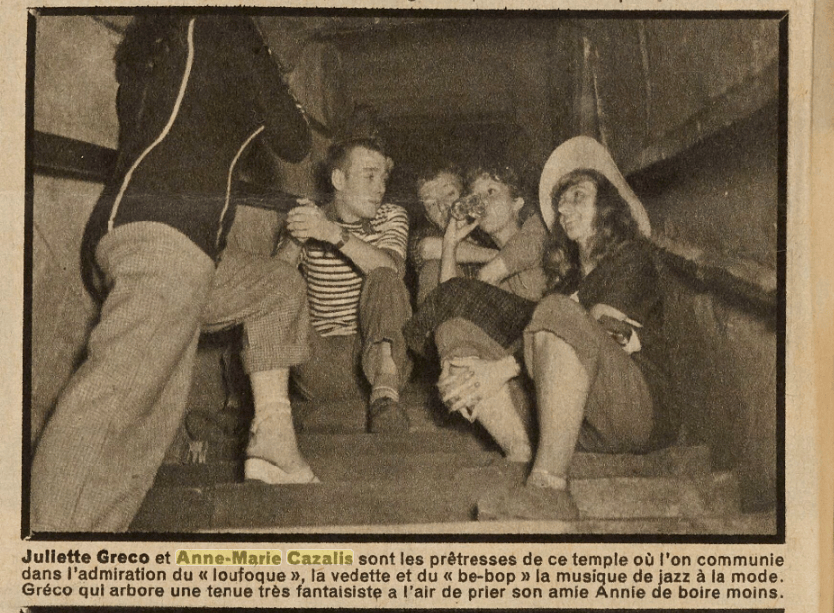
Astruc became part of the Saint-Germain-des-Prés core centred on the clubs Le Tabou and the Club Saint-Germain; L’Aurore even dubbed him one of the scene’s “Big Five”. He was so entwined with it that he dated Anne-Marie Cazalis, best known as Juliette Gréco’s best friend. He sat on Le Tabou’s club committee with Gréco, Cazalis, Boris Vian, Frédéric Chauvelot, Jean-José Marchand and Jean Genet, which announced it would award a 50,000-franc literary prize to a young author in Megève.
The event didn’t take place in Megève, because the backer baulked at the expense, and like most things in Saint-Germain it descended into mayhem. Vian was away in Nice playing trumpet with Claude Luter; Genet was untraceable. The judges met instead at a restaurant on the rue Tardieu in Montmartre, where proceedings collapsed into endless, deliberate name-calling: “Bastards! Sellouts!” Gréco and Cazalis screamed at their fellow judges. Astruc supposedly scratched Cazalis before the jury settled on two prizes, one to a writer named Schitting for Qui n’entend qu’une cloche, the other to Sally Mara for On est toujours trop bon avec les femmes. Sally Mara was Raymond Queneau’s pseudonym. Shortly afterwards Dizzy Gillespie turned up, and they unanimously crowned him “King of Le Tabou”.
Typical. As one Le Tabou regular muttered at the time: “To think we wanted to avoid making this prize a laughing stock! Well, that was a roaring success!”
Astruc himself was an eccentric. Boris Vian wrote in his Manuel de Saint-Germain-des-Prés that Astruc had an odd beard, claimed a genius akin to Orson Welles and William Shakespeare combined, and had a peculiar style of dancing that reduced an ordinary shirt to a wet rag “in the time it takes an ordinary person to hard-boil an egg under their armpit.” Astruc later clarified that, despite popular rumour, he and Vian were never actually friends.
The Welles–Shakespeare comparison comes up a lot. Juliette Gréco nicknamed him “Alexandre ‘Orson William S.’ Astruc” in her autobiography, and described how he would concentrate by lying on his bed with a small cloth over his face.
Aller et retour (1948)
It was after writing “Caméra-stylo” that Astruc began moving into filmmaking. Pierre Braunberger first asked him to make a documentary about the Buttes-Chaumont gardens based on a text by Louis Aragon, but instead he made a little fiction film, Aller et retour, its title a tribute to Marcel Aymé.
It follows a veteran of the Spanish Civil War who narrowly escaped execution and recounted his ordeal in a best-selling novel, only to grow indifferent to everything. The cast included Gréco; Marc Doelnitz, the party king of Saint-Germain-des-Prés; and Sylvia Bataille, the ex-wife of Georges Bataille and future wife of Jacques Lacan.
It was shot in the offices of France-Soir and in Frédéric Chauvelot’s apartment. The film promised something revelatory, like an intimate diary, but when Astruc finished editing it he put it away and never premiered it. Whether it still exists is unknown. The only anecdote Astruc ever offered was that François Truffaut, long before Cahiers du cinéma made him famous, rescued its outtakes from the editing room at Travail et Culture and pinned them to his wall.
Ulysse ou les Mauvaises Rencontres (1948)
The more tantalising of the two shorts is this one. Ulysse ou les Mauvaises Rencontres was only ever a provisional title, and little time was spent deliberating over it. The idea was simple: the Iliad and the Odyssey condensed into modern Saint-Germain-des-Prés, all filmed inside the Théâtre du Vieux-Colombier and funded by Anet Badel, the theatre’s director, who had also financed Jean-Paul Sartre’s Huis clos.
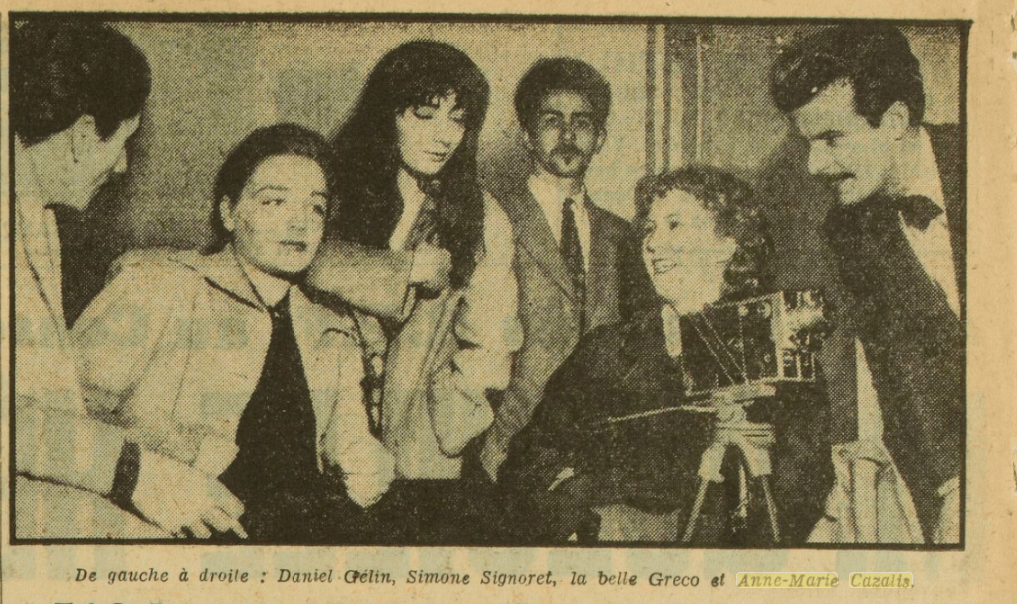
The film was the brainchild of Jean Cau, Sartre’s secretary, and Anne-Marie Cazalis, who came up with it on the spot in front of the journalist Paul Maury. It was about a man returning home from a long voyage, meeting women and trying to get past these “Sirens” to return to his wife. They chose the Odyssey because, obviously, Homer charged no royalties.
Cau was meant to direct it, but got bored, so Astruc took over. Cazalis drew up the synopsis and script and left the technical side to Astruc. Shooting took place at night, because during the day the theatre was performing Lucienne et le boucher, and they worked through until dawn for eight to ten days. In the end it was something of a private joke: a cabaret, a farce.
Contemporary accounts put Cazalis at the centre of it all. She was the bigger name at the time: she had won the Paul Valéry Prize and was a fixture in the press as Saint-Germain’s “high priestess”, and some reports even announced that she was directing the film. She wasn’t, but the papers’ choice of name makes a nice irony. Astruc had just written the essay that made the director the author of a film, and the press credited his first real attempt at one to somebody else.
Ulysse‘s Cast
Because you can’t see Ulysse ou les Mauvaises Rencontres, the most interesting thing about it is its cast, which is impressive whatever else you think of the film. It was also clearly fluid and remains very poorly confirmed. Here’s my attempt at a definitive cast list. Numbers refer to the sources at the end.
Confirmed
| Actor | Role | Sources |
|---|---|---|
| Daniel Gélin | Telemachus | 1, 11, 12, 14, 15, 16 |
| Marc Doelnitz | Ulysses | 1, 11, 12, 14, 16 |
| Christian Bérard | Neptune | 1, 11, 12, 14, 16 |
| France Roche | Helen of Troy | 1, 14, 16 |
| Janine Senneville | A siren | 1, 14 |
Gélin described Doelnitz, his Ulysses, as “as pink-cheeked as a Scottish schoolgirl, adorable, fickle”.
Disputed
| Actor | Role(s) as credited | Sources |
|---|---|---|
| Jean Cocteau | Homer / narrator | Homer: 1, 16; narrator: 11, 14 |
| François Chalais | Paris / Menelaus | Paris: 1, 15; Menelaus: 14, 16 |
| Yvonne de Bray | Pythia / Circe | Pythia: 1, 16; Circe: 15 |
| Anne-Marie Cazalis | Chorus / siren | Chorus: 1; siren: 14 |
| Gaby Sylvia | Siren / Nausicaa / Penelope / Circe | Siren: 1; Nausicaa: 11, 14; Penelope: 12; Circe: 15 |
| Boris Vian | Chorus / Destiny (silent role) | Chorus: 1, 16; Destiny: 14 |
| Juliette Gréco | Circe / Calypso | Circe: 1, 16; Calypso: 11, 14 |
| Simone Signoret | Penelope | 1, 11, 16 |
| Jean Genet / Alexandre Astruc | The Cyclops | 15, 16 |
As you can see, it’s ambiguous, and that’s likely the production’s fault. Note how most of the women’s roles cross over: two actors are credited as Penelope, and three as Circe.
Whether Cocteau was ever designated “Homer” or not, it’s fairly obvious where the assumption came from. François Chalais joined his wife, France Roche, but accounts can’t agree on whether he played Paris or Menelaus. Boris Vian was not, as is sometimes claimed online, a Lotus Eater, though that feels like the role he should have had.
With Gaby Sylvia there is extra ambiguity over why she was there at all. Astruc claimed he wanted her because he admired her, while other sources say she was cast to secure Anet Badel’s money, as she was his wife.
Simone Signoret is credited as Penelope, but she may only have visited the set once. Jean Genet was cast as the Cyclops but never showed up, being on the run from the law at the time; Astruc took the role himself, “somewhat terrifying”, according to Daniel Gélin.
There are also several single-source claims that can’t be asserted with confidence: a Roberta as Circe (11), Jean-Charles Tacchella in an unnamed role (8), Jean Marais (13), Raymond Queneau, Claude Luter and Michelle Vian (17), and Annabel Buffet (15, 18). Names such as Sylvia Bataille, Danièle Delorme and Henri Troyat circulate online, but I’ve found no evidence for them.
Much of the announced cast simply didn’t turn up. Cazalis brashly told the press that Dolores del Río would play Charybdis and Scylla, and she didn’t.
Filming Ulysse
The shoot was itself a mini-episode of weirdness. To show Neptune in his marine kingdom, Astruc filmed Christian Bérard through the frosted-glass portholes in the theatre doors while pouring water over them with a sponge. This was apparently an improvement on, and safer than, the original idea of having him splash around in a bathtub. Bérard’s Pekingese dogs were brought in as Neptune’s triumphal dolphins.
France Roche and François Chalais were arguably the best-known film critics of the Saint-Germain-des-Prés set, and the professional actors in the cast enjoyed mocking them. Their role was simple enough: a pair of famous actors taking a bow on stage. All they had to do was hold hands and walk toward the footlights. Gélin gleefully recalled how they made the critics repeat it over and over.
Gréco’s main memory of the shoot was her make-up. In despair, she asked Simone Signoret how to soften her nose in front-on shots and was told to put a little red on the tip. Gréco did it “so poorly that she ended up looking like a sad, white clown. A vermilion nose.”
The whole thing was such a farce, with an inconsistent cast, a great deal of press attention and very little money, that Badel denied being the film’s producer, and the crew had to hunt for loose change to pay for film stock. They told the press there would be a screening at the Rex as part of a 16mm film festival, which never happened.
Cau later dismissed the script as “completely burlesque… a vague improvised story that ended in fiasco. It was a young person’s joke.” Gélin said the film was so badly made that it was incoherent and impossible to edit. Astruc himself dismissed the idea that it had any merit at all.
In the end Astruc handed the reels to Anet Badel, and that’s where the trail stops. Nobody knows whether Badel got rid of them. Gréco said she never knew; Astruc claimed Badel took the reels with him when he fled to Switzerland in 1965 over a tax scandal.
Afterwards
The project was the last hurrah of the Saint-Germain-des-Prés scene. The failures set Astruc back but didn’t put him off. When he eventually met Anatole Dauman, he was determined not to repeat his mistakes, and pitched a small, contained script adapted from a literary work: Le Rideau cramoisi (1952). Ulysse was never finished, but much of its milieu can be seen in Jacques Baratier’s Désordre (1950).
Seven years after those nights at the Vieux-Colombier, Astruc gave his first full-length feature the same title, Les Mauvaises Rencontres. Queneau had told him that one essay had already earned him posterity. The man who argued that a director should write with a camera the way a novelist writes with a pen then made two films nobody has ever seen, and the press tried to give the credit for one of them to somebody else.
Sources
- Bertrand Dicale, 2001, Juliette Gréco: Les vies d’une chanteuse
- L’Aurore, January 1950
- Oran Republicain, January 1948
- Liberation, January 1948
- Point de Vue, March 1948
- L’Intransigeant, February 1948
- Boris Vian, 1951, Manuel de Saint-Germain-des-Pres
- Alexandre Astruc and Noël Simsolo, 2015, Le plaisir en toutes choses
- Juliette Greco, 1982, Jujube
- Combat, November 1948
- Liberation, November 1948
- Les Lettres Françaises, November 1948
- Paul Webster, 1984, Saint-Germain-des-Pres
- Cinevogue, November 1948
- Daniel Gélin, 1977, Deux ou trois vies qui sont la mienne
- Françoise Piazza, 2020, Juliette Gréco: Entrer dans la lumière
- Philippe Boggio, 1993, Boris Vian
- Jean-Claude Lamy, 2011, Et Dieu créa les femmes: Brigitte, Françoise, Annabel et les autres…
- Cinemonde, November 1948
- Le Figaro, July 1950


Leave a Reply