Anna Karina and Jean-Luc Godard married in March 1961; a few months later, Karina would have a miscarriage. In November 1961, the press announced that Godard and his Danish bride were divorcing. In January 1962, they started filming Vivre sa Vie. They wouldn’t divorce for several years yet.
The subject of Godard and Karina goes back and forth. Romantic to hellish. His fault to… well, most people agree with his side of the fault, but Karina from sinless angel (Like Joan of Arc) to… not so sinless.
The thing about Godard and Karina is that Godard never spoke of her beyond the occasional comment for sixty years, while Karina spoke on the subject, never quite sure if she felt honoured to be a muse, constrained by the concept, part of an iconic love story or a match made in hell. As such, her interviews range from understanding ‘Ah, he was a great artist’ to societal ‘Women back then had no rights’ to accusatory.
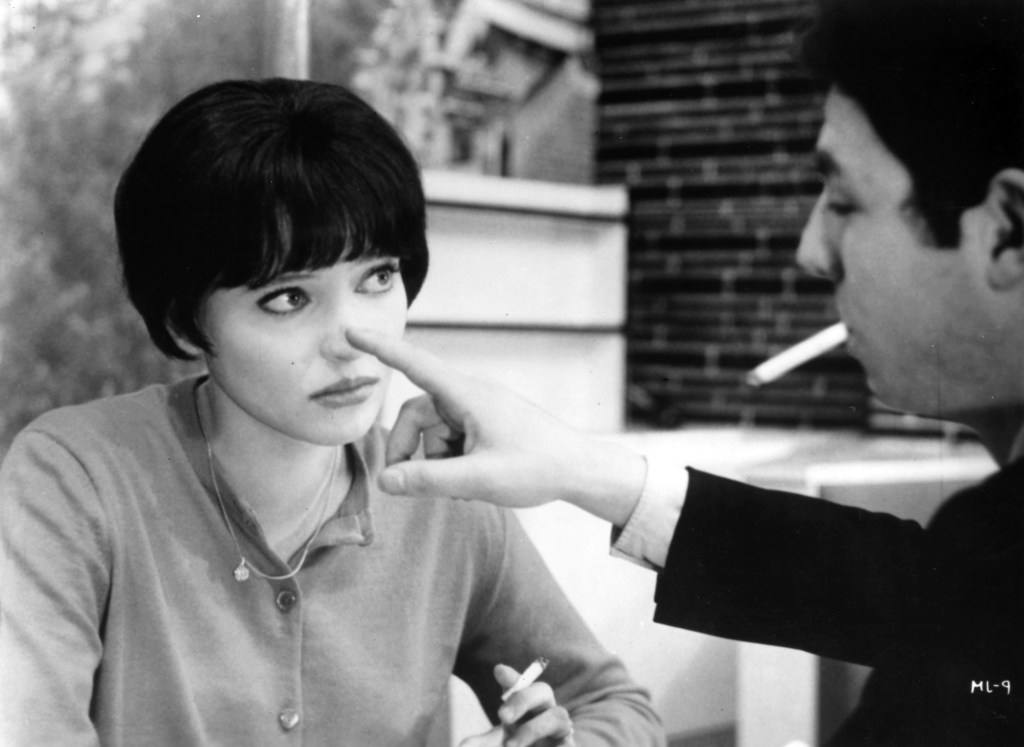
ANNA KARINA
Vivre SA vie – 1962
For as big as the Karina-Godard relationship is in iconography, it does not work neatly. They met, got pregnant, got married, spent four-ish years in chaos, divorced, and then made three films together either during or after the divorce. What is fair to say is that the relationship was always Karina looking for something Jean-Luc refused to give, and Jean-Luc furious that she’d look elsewhere for it.
The miscarriage came in early May 1961; one day, Jean-Luc Godard returned to his rue Nicolo apartment to find his wife lying in her own blood. He rushed her to the hospital and spent ten days sleeping by her side. He tried to comfort her after – he gave her a ring from Cartier, a pair of small dogs and rented a villa near Nice for her convalescence. It would seem Godard was trying to beat being Godard for a moment. But something had broken in the love story.
Karina was rendered sterile after the operation. Sterile at 20. Karina claims she struggled with Godard’s secrecy. That she started resenting his preoccupation with work and seeming refusal to address (or understand) what’d happened to her. He became absent: Rome, New York, Stockholm, with little word to Karina, who was left feeling abandoned.
“He taught me everything, he became at once my lover, my husband, my brother, my father, at once my best friend and my best enemy. It was natural that I clung to him. I think it irritated him greatly until the day I stopped clinging. Then it was he who clung to me. Then, afterwards, life separated us for good.”
Anna Karina [1]
Karina’s struggles are well known to cinephiles; less known are Godard’s. Across the backdrop of Summer and Autumn 1961, Godard was met with the collapse of the French New Wave, exhibitors looking for someone to blame for the decline in admissions (E.G. TV was at fault, but TV is harder to blame and the New Wave had earned a lot of enemies by being snotty brats in the 50s), decided that it was the New Wave’s fault, them and their ‘miserablism.’
Godard lost his Eva project (The Hakim Brothers gave it to Joseph Losey instead) and his Mouchette project (later made by Robert Bresson in 1967), and A Woman is a Woman was commercially a flop. He was in a depressive phase, according to Antoine de Baecque’s Godard. He would call Georges de Beauregard and Jean-Pierre Melville to tell them he was going to kill himself. They fought constantly. Godard smashed stuff up at home, attempted suicide once.
The relationship broke. Godard strayed first; affairs broadly with young actresses or the type of girls who orbited productions, Michel Deville’s secretary or Catherine Ribeiro (Who played Cleopatra in Les Carabiniers). Karina would start too, she’d say her doing so was “Above all a kind of response”
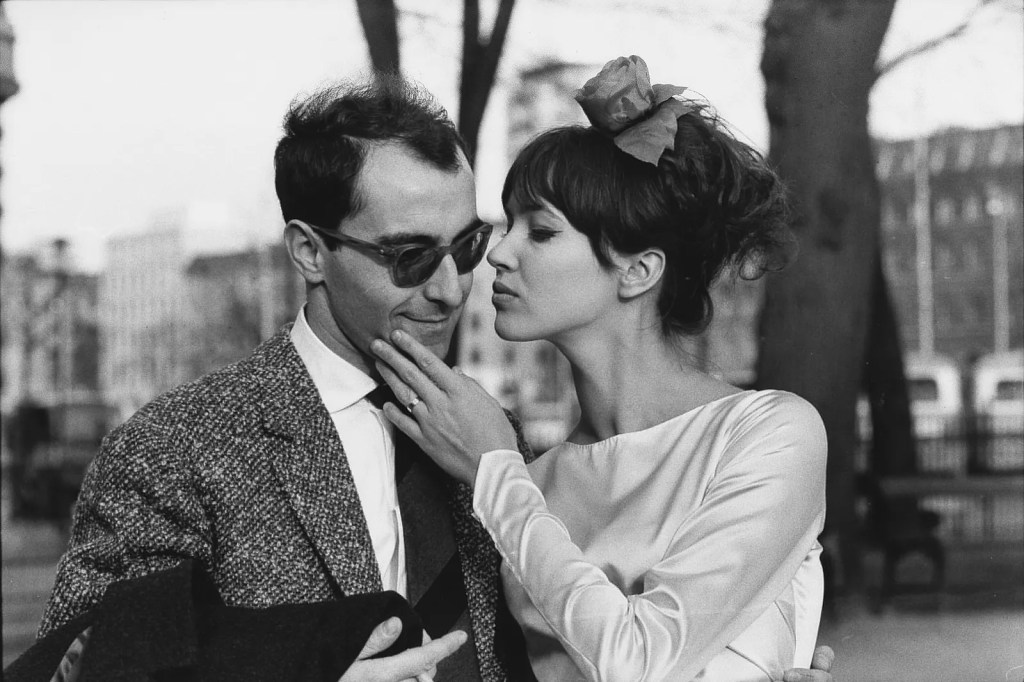
ANNA KARINA and Jean-Luc Godard
But is that true? Well, it’s hard to know. But it brings us to a very little-known fact. In September 1961, Anna Karina started working on Le Soleil dans l’oeil, mostly in Corsica. The film itself is a forgotten work, hardly accessible anywhere, but Karina plays a Danish woman who goes to Corsica to follow a man, dressed in a Bardot-like wig. The young man was played by Jacques Perrin, who was fresh from Valerio Zurlini’s Girl with a Suitcase and looking like he’d become the next Delon (He wouldn’t he’d be much more interesting).
France-Soir ran a photo of Karina on set, celebrating her twenty-first birthday on September 22 1961, blowing out candles with Godard and Perrin watching.
It was the same paper that reported in late November 1961 that Anna Karina had been hospitalised “following a suicide attempt.” In the article, the journalist explained the reasons behind the despair and reported that Karina was leaving Godard, having decided to marry Jacques Perrin “I admire Jean-Luc enormously,” she said, “but he is of another generation. Whereas Jacques is my double.”
It was the night of the 21st of November when Karina told Godard she was leaving. He flew into a fury – he destroyed the entire apartment (including notably Karina’s “teddy bears”), then he left, and Karina swallowed a tube of barbiturates. Perrin found her and called an ambulance, and she was taken to the hospital, then convalesced in the apartment of Eric Schlumberger, producer of Le Soleil dans l’oeil.’
It was here at her bedside that Godard and Perrin found themselves together, and in an act that can only be called ludicrous, “played” for her with dice, then poker, before photographers interrupted. It seemed clear that Godard and Karina were going to get a divorce. Then, in January, without much in the way of clarity over this peculiar affair, they announced they were making a new film together. Attached was a tender photograph of them together.
There is frustratingly little on this subject. Perrin never mentioned it (At least in any source I can find), nor did Karina or Godard.
Vivre sa Vie
It is very hard not to read Vivre sa Vie through the lens of this information. Godard made it with the express intent of making Karina a respected star… and yet the film features many references to Nana’s desire to pursue acting, drawing a disturbing analogy between Karina, the actress, and Nana, the prostitute.
In case the aspersion wasn’t clear, Godard had one of the pimps, Luigi, played by Eric Schlumberger, the man who’d produced Le Soleil dans l’oeil, the film that brought Karina and Perrin together.
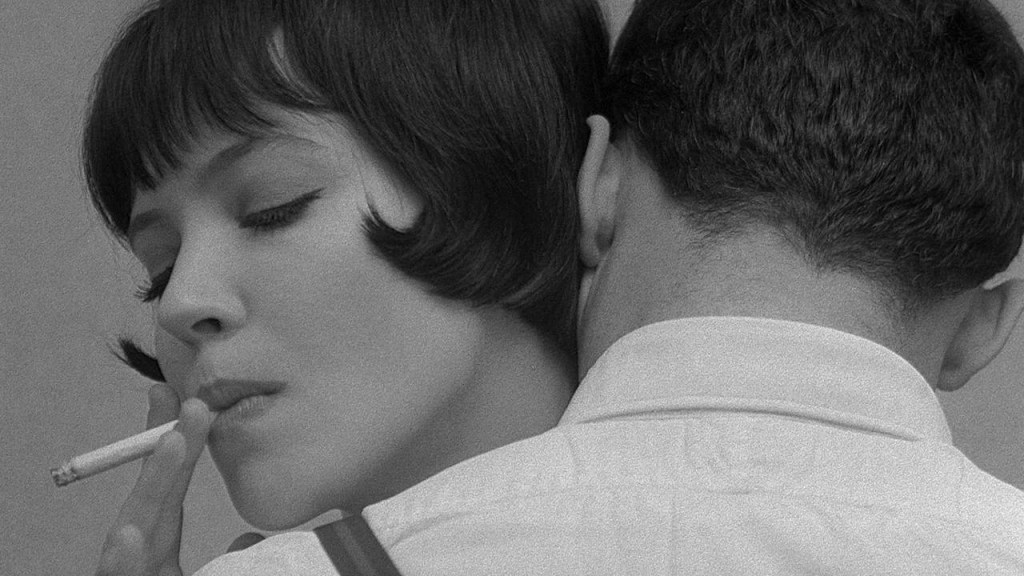
ANNA KARINA
Vivre sa vie – 1962
Then there’s the penultimate tableau where the young man reads Nana a passage from Poe’s ‘The Oval Portrait.’ The story of a painter so consumed with rendering his wife’s likeness that he doesn’t notice the life drawing from her; she dies when the painting is finished. Godard put that into the film about himself, a planted confession.
If that’s not enough, the film ends with a stunning show of puritanism. Nana, who’d been so brazen in her adultery at the beginning, lies dead on the pavement. A cautionary tale of infidelity, the fall for betraying her husband. You can make a reading that most of Godard’s films from 1961-65 contain the same warning to Karina; across different films and guises, you can see how a woman’s faithlessness leads to a false step into a new world that collapses into tragedy. It’s a classic, really.
The real irony of the film is Karina’s performance in it. She is spellbinding; it is hard to think of an actress who could pull off the role as she does. That expressive face. The close-ups. And the film worked in establishing Karina as a star; it is easy to forget, but she was, before Vivre sa Vie, just some director’s ex-model wife who’d been in a few disposable films.
Post-Script
Six months after Perrin, Anna Karina met Maurice Ronet at a film festival in Acapulco, Mexico. They would embark on a long affair, and Godard would use that affair to propel Une femme mariée. Karina hoped Ronet would marry her; Ronet preferred the single life, but this was ultimately the straw that broke the Godard-Karina marriage, finally, by 1964.
As for Perrin, little can be said. But an interesting note is that despite the background in 1969, he donated three thousand dollars to Godard’s attempt to film a commission for the Arab League on the Palestinian struggle for independence. It was meant to be called Jusqu’a la victoire, but it wasn’t made.
Sources
- Godard. Antoine de Baecque, 2010
- Everything is Cinema: The Working Life of Jean-Luc Godard. Richard Brody, 2008
- Be Beautiful and Shut Up: Anna Karina on Filmmaking with Jean-Luc Godard. Caveh Zahedi, 2016
 Bronze Screen Dream
Leave a comment