Jean-Luc Godard famously spent 1963 – 1973 in a progressive spiral towards radicalism and breaking cinema; there are those whose names are well-known in connection to his in this period: Jean-Pierre Gorin, Laszlo Szabo. But another name sitting there is Patricia Finaly. But who is Patricia Finaly, and why does she have no digital footprint at all? Why, after decades of New Wave archiving, has she managed to be ignored?
Did she simply do nothing? No, she survived the holocaust, was central to Parisian cinematic life and wrote books. She is a fascinating case of someone whose life certainly deserves rediscovery.

Patricia Finaly was a production designer on
Bande à Parte – 1964
Where Did She Come From?
Patricia, born ‘Ruth Patricia Rosenblum’, was born on 8 September 1932 in Germany. She was a Holocaust survivor, and her parents never returned from Buchenwald. She spent her adolescence between Israel and France. To survive, she took part in the Tichadel tours as a nude dancer. [1]
It’s unclear when exactly, but at some point she took the name ‘Finaly’ as her surname; speculatively, this could be related to the Finaly affair, but there’s no proof of this. Regardless, she was known to all as ‘Finaloche.’
At some point around Spring 1962, Patricia was at a cafe on the Avenue Montaigne when her bag and money were stolen. She cried, she wept, she raged, and two women came to her aid and comforted her: Anna Karina and Delphine Seyrig, who were working on La Religieuse opposite the cafe at the Studio des Champs-Elysees. This led to a friendship, which led to Karina hiring her as her personal dresser for her upcoming show.[2]
After the play was finished, Godard would take her on as a ‘temporary’ secretary; the interim would last two years. Meanwhile, she acted in the rehearsals of Godard’s adaptation of Pour Lucrece, which he planned to turn into a feature but would call off in September 1962 after rain led to a delay. [3] During these performances, Finaly acted completely naked in red smoke in a scene of the Guingamp celebrations; a scene that made Jean-Pierre Giraudoux, the playwright’s son, apoplectic with anger. [1] [2]
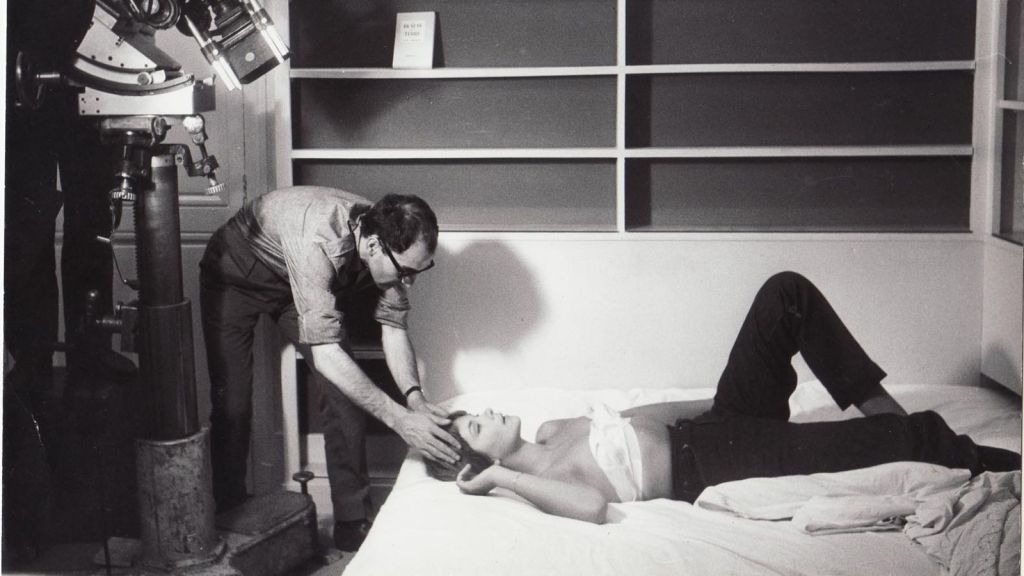
Jean-Luc Godard and Macha Meril on Set
Une Femme Mariée – 1964
Anouchka Films
From Autumn 1963 until 1973 (Though exact dates vary between 1967-73 in reports), Finaly worked as secretary, assistant and confidante to Jean-Luc Godard at Anouchka Films at 25 rue Marbeuf. She also, at some point, worked as a secretary for Francois Truffaut and Antoine Bourseiller. [1]
Finaly would work in the Production Department on Godard’s Bande à Part and Une Femme Mariée (Both 1964); it was during Une Femme Mariée’s shoot that she played go-between between Godard and Karina during the disintegration of their marriage [4]
By Finaly’s own account, she did “Everything” at rue Marbeuf: She managed the office, did admin, typed up Godard’s notes and went to see films to write reports so Godard could decide whether to go himself. Meanwhile, she, at the filmmaker’s request, followed Anna Karina everywhere; simultaneously friend, confidante and spy, and had to balance his erraticness, like telling Karina he was on a shoot when he wasn’t.
Godard was interfering in her love life. He made her sell her apartment, have her abortion in Switzerland and mocked her as ‘Marie-Antoinette of the suburbs’ side. Godard once made her see every D.W Griffith film after she’d commented she found him boring, or else he’d fire her.
Yet, by Finaly’s account, he let her get away with everything, and she let him get away with everything too, “because he has always been very unhappy.” According to Antoine de Baecque’s Godard, Finaly wrote a memoir of her ‘Anouchka years,’ but it remains unpublished. [2]
Connections
Finaly wasn’t just Godard’s secretary though. She was also, seemingly, everywhere. She was part of the infamously funny interview Jean Eustache, Andre S. Labarthe and Bernadette Lafont had with Paul Gegauff from 1967-68, which was halted from publishing by Cahiers du Cinema (Too many dark stories on Godard, Rohmer, and Chabrol) but eventually released in the mid-nineties. [5]
Beyond this, she was simply all over the place. She was on TV shows (Like Post Scriptum, Itineraires de femmes and A bout portant), and she interviewed Joe Dassin in 1971. She was called “extraordinarily stupid” in Jean-Patrick Manchette’s journals, and she is even mentioned in Truffaut’s famous “You’re a shit.” letter to Godard in 1973. [6] [7]
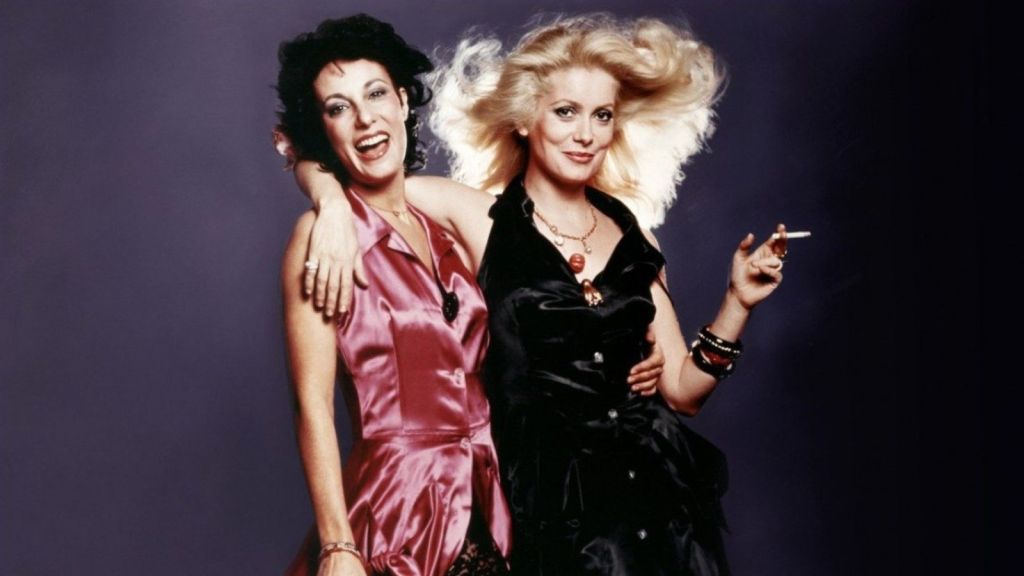
Promotional Shot of Deneuve and Lafont
Zig-Zag – 1975
“I love Jean-Pierre Leaud, Janine Bazin, Patricia Finaly (and she’s just out of a nursing home and has had to pester the Cinematheque over and over again for her six months’ back salary)” [8]
The best source on her comes from Bernadette Lafont’s book, Le Roman de ma vie. Across the book Lafont describes her as overflowing with “generous energy”, helping Lafont mount her comeback, introducing her to Jean Eustache (Which would lead to her appearance in The Mother and the Whore) and credits her with putting on a screening for Laszlo Szabo, and persuading Claude Berri and his wife Anne-Marie to finance his film Zig-Zag; which she would also work in the production department for. [9]
Lafont describes her as:
“Very left-wing, always has a ’cause’ on the go. Some evenings, seized by a wandering fever, she prowls the streets from Saint-Germain to Montparnasse. With her flame-red hair and purple cape snapping in the wind, you’d think you were watching the flag of the revolution go past.” [9]
The Gay Ghetto
In 1970, Finaly published her first novel, The Gay Ghetto; Jacques Rivette suggested the title. It told the story of her youth. Her life as a little German Jewish girl, her family’s deportation, how she went from children’s home to convent, then convent to farm, then farm to orphanage, constantly changing her identity. It went beyond the war, too, and was one of the first books to really handle the OSE children’s home. [10]
Finaly is an excellent writer. Darkly humorous, offbeat, innovative and idiosyncratic, but the book itself is loaded with self-hatred. Towards both herself and Judaism. Indeed, Lucille Cairns, in the impressive Post-war Jewish Women’s Writing in French: Juives Francaises Ou Francaises Juives? covers extensively how caustic her writing is, how parodic and bitter she is. How she plays into anti-semetic stereotypes. Indeed, on her own interview on Vacances, she stated she hated being reduced to her Jewish identity and declared, “I don’t give a damn about religions,” [11]
Labarthe
It is at this point that a twist comes in. Well, it’s not a twist, not really, because it’s been happening since 1964 when Finaly met Andre S. Labarthe at the Annecy Festival. They became lovers quickly and instantly fell into a deep, passionate affair. Godard told her at the time, “You are going to suffer as you have never suffered.” [2]
In retrospect, Godard was right.
Labarthe is best known for his critical writings for Cahiers du Cinema (He was part of the same writing cohort as Truffaut, Godard, and Chabrol), his work with Janine Bazin on Cineastes de notre temps and for starring in Vivre sa Vie. He was very well-regarded in their circles and a bit of a dandy. Lafont noted that “I find him seductive with his raincoat, his hat and his cigarette, but there’s no question of having an affair with him. I love Patricia too much.” [9]
Labarthe and Finaly lived together in an apartment on rue Berthe (whose key money Godard paid for). She was deliriously happy and in love. Labarthe seemed to be too. Until one day Finaly discovered he was having an affair. This was the start of her nightmare: She spent long spells in mental hospitals, had a long addiction to Valium, and experienced multiple suicide attempts. She would write up the experience into Tropique du Valium, published 1978, which retells her situation in a breathless tone.
You’d call it Erotomania. The clinical term for obsessive, delusional fixation on another person, but the clinical language makes it feel more devoid than what she writes. She writes about vomiting blood outside Place de l’Opéra, unable to not think of Labarthe; she speaks of Daniele Delorme driving her to the psychiatric hospital and of refusing treatment due to not wanting to close the door on Labarthe. In and out. Labarthe on the periphery, Finaly unable to escape this vortex.
Christmas becomes her fixation. She wants to be with him at Christmas every year until her death; Labarthe promises her this and gives her three days. Between the 23rd and 26th of December every year, but this makes her life only live for those three days. She takes pills to stop noticing how long between the Christmases; she is prepared for anything: Humiliation, blackmail, to make sure he’s with her on Christmas.
But Christmas too becomes part of the nightmare as she becomes obsessed with making sure it happens. She sends thousands of letters and thousands of phone calls, always with the same message of “Say you won’t abandon me. You’ll take me at Christmas.” She makes mutual friends call Labarthe to insist he uphold his promise. With blackmail, coercion and humiliation. [12]
It’s a tragic book. It had a brief resurgence of interest in the early 90s when Pierre Utterhoven, the screenwriter of Claude Lelouch, adapted it for a TV episode of Mercredis de la Vie; the episode broadcast in April 1992 as ‘Pour trois jours de bonheur,’ and it got some press coverage. [13] [14]
Patricia Finaly disappears from the record after the book was published, aside from some interviews and appearing on a radio program celebrating Andre S. Labarthe [15] in 1994. The very last record of her is from interviews she did with Antoine de Baecque in 2008, and she also features in a wonderfully idiosyncratic documentary on Godard, Tenis con JLG (2002). [16]
What she did from 1978 onwards is unknown; whether she and Labarthe kept up the Christmas routine is unknown. She would die on 3 October 2010 in Paris, 18th arrondissement, in the same geographic world of her rue Berthe apartment she’d shared with Labarthe. Labarthe would follow in 2018.
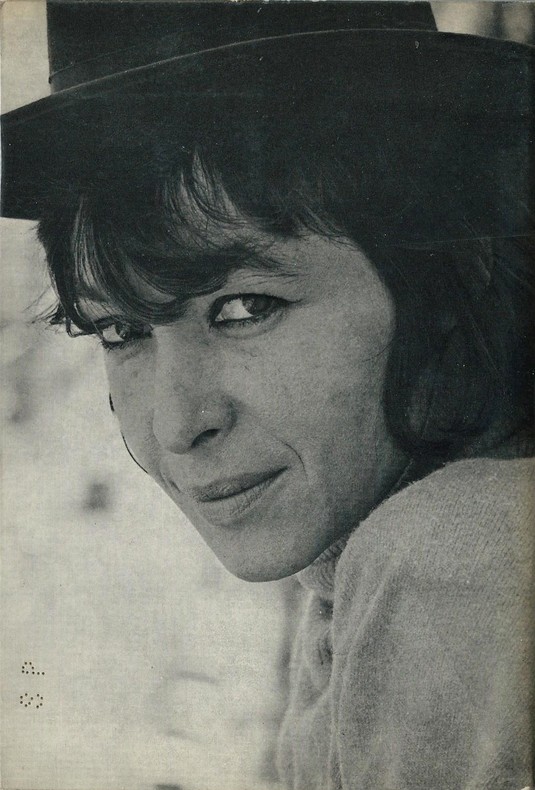
Photo of Patricia Finaly from her book covers
References
- Senses of Cinema, Antoine Bourseiller
- Godard. Antoine de Baecque, 2010
- Unfinished Business: Godard, Cinema and Theatre in the 1960s. Michael Witt, 2020
- Everything is Cinema: The Working Life of Jean-Luc Godard. Richard Brody, 2008
- Jean Eustache: un amour si grand. Philippe Azoury, 2023
- Joe Dassin – Interview de Patricia Finaly
- Journal 1966-1974 Volume 1. Jean-Patrick Manchette, 2015
- Correspondence 1945-1984. François Truffaut, 1988
- Le roman de ma vie. Bernadette Lafont, 1998 · archive.org
- The Orphans of the Holocaust: Houses of Hope (1944 – 1960). Katy Hazan, 2000
- Post-war Jewish Women’s Writing in French: Juives Francaises Ou Francaises Juives?. Lucille Cairns, 2017
- Tropique du Valium. Patricia Finaly, 1978
- Un veneno llamado amor : de pasiones, celos y muertes, Carmen Posadas, 1999
- Le Nouvel Observateur, February 1990
- France Culture – André S. Labarthe, Les Nuits, Radio
- Tenis con JLG (2002). Vimeo


Leave a Reply