Marc’O is the man who fought in the French Resistance as a teenager, got drunk with Boris Vian, produced the seminal Lettrist film, introduced Guy Debord to Lettrism, discovered Bulle Ogier and accidentally got Les Rita Mitsouko founded. But look online, and you’ll see absolutely no serious English-language attempt at engaging with his career.
You’ll find some reviews of Les Idoles (1968) and some references to Lettrism, but that’s it. But why? Is this a case of someone who was just so willfully underground that having his day in the sun was never going to come? Maybe. But if so, sorry, today’s the day.
Marc’O’s Involvement in Lettrism
Marc-Gilbert Guillaumin (who would later, at some point in the 1950s, start going by Marc’O) was born in Clermont-Ferrand on the 10th April 1927. He would join the French Resistance at 16 in the Allier department and see combat during the Battle of Mont Mouchet with the Maquis du Mont Mouchet on 11 June 1944. He would be injured in that battle (the Germans won), but later still take part in the liberation of Auvergne. In February 2025, he would be appointed a Knight of the Legion of Honour for these actions.1
At some point by the late 1940s, Guillaumin found himself in Paris, where he immersed himself in the Bohemian nightlife of Saint-Germain-des-Prés. He adopted his pseudonym ‘Marc’O’ and organised poetry readings and events at places like Le Tabou with people like Boris Vian. Vian was already close friends with Gabriel Pomerand, so it is fairly likely it was this connection that linked Marc’O in with the lettrists.2
Regardless, in October 1950, with Michel Le Clerc (another very interesting figure who did a lot but didn’t seem to leave much of a trail), he hosted four highly publicised Lettrist recitals in Paris that included Isidore Isou, Gabriel Pomerand, Maurice Lemaitre, Serge Berna, Jean-Louis Brau, Francois Dufrene and Gil J. Wolman. Anyone familiar with the names will know that this was essentially the core of the Lettrist movement.3 4
It was Marc’O who produced Isidore Isou’s radical non-narrative film Venom and Eternity (1951), which he and a few of his Lettrist friends forced the Cannes Film Festival to put on in 1951. This was something of a minor outrage and caught the attention of Jean Cocteau.5
Marc’O would edit two Lettrist journals, Ion and Soulevement de la Jeunesse (Youth Uprising). Ion is particularly interesting because it is where Marc’O both became the first person to publish Guy Debord (who included his script to Hurlements en faveur de Sade in the journal) and where Marc’O would express his core film theory: “First Manifestation of a Nuclear Cinema“. In this text, Marc’o articulated much of what the Situationists would go on to propagate at length. He would advocate for a systematic dismantling of passive spectatorship in cinema and propose several ways to alter the sensory conditions of cinema, like “Aquarium Cinema” (which was watching film projected through a large water tank to distort the image) and “Disrupted Spectator” (which forced audiences to wear lenses that shifted optical focus every 30 seconds).6 7
Soulèvement de la Jeunesse was Marc’O’s journal, which represented the mid-way point between Isou’s loyalists and Debord’s Situationist break-offs. Marc’O’s group was called The Externalists. It was relatively short-lived and included works by Pomerand, Marc’O, Poucette (Marc’O’s wife), Jacques Spacagna and Yolande du Luart (later known for her Angela Davis film). It also has the unique distinction of being the journal that first published text by Yves Klein. The Externalists wouldn’t last long.4
Closed Vision
Youtube
Closed Vision – 1954
In 1954, Howard Hughes sent Leon Wickman to scout for new talent in France, where he would find Marc’O and produce his debut, Closed Vision. The film was a radical cinematic experiment and was shot by future director Jean-Gabriel Albicocco (Who Guy Debord hated), and its cast was largely Cannes locals and Merlin Hare, the son of Jacqueline Lamba, Andre Breton’s ex-wife. The film itself came and went without much impact, but was presented with considerable interest at Cannes by Luis Buñuel and Jean Cocteau.6 8
Cocteau’s introduction to the film was:
Mesdames, Messieurs,
Même si je désapprouvais le film de Marc’O et de Yolande du Luart, produit par Leon Vikman, ce qui n’est pas le cas, je le présenterais quand même. L’important, c’est qu’il existe et qu’il veuille vivre : Vous n’ignorez pas les obstacles que l’industrialisation actuelle du cinématographe oppose à la jeunesse. Or, le film est un admirable moyen pour que la jeunesse s’exprime et elle n’y arrive presque jamais. Un jeune a fait son film, même s’il se trompe, on le salue.
Lorsque Buñuel tournait L’Âge d’or, même si Le Sang d’un poète, il y a presque trente années, nous ne nous doutions pas que ces films se projetteraient sans cesse, battraient tous les records, et fixeraient l’esprit d’une époque. De loin, les styles antagonistes où qui semblaient être antagonistes se confondent et Buñuel nous raconte qu’au Mexique, où il habite, il arrive qu’on lui attribue Le Sang d’un poète et qu’on m’attribue le Chien andalou.
Il est possible que Vision closed [sic] fixe l’esprit d’une époque qui est la nôtre et que le manque de recul nous empêche d’observer avec clairvoyance ; il est possible que cette époque, avec le recul, déplaise, et je le répète, je ne juge pas.
Salvador Dalí, dont vous connaissez la collaboration jadis fraternelle avec notre ami Luis, me parlait l’autre jour à Madrid, d’une science qu’il baptise la phoenixologie. C’est la science qui consiste à mourir et à renaître plusieurs fois de suite en chair et en os. On observe ce phénomène et on le retrouve en Vision closed. Il faut donc admettre, qu’il existe une tradition de l’Avant-garde, ou de ce que l’on affiche à tort comme telle.
En effet, un jeune homme qui s’exprime avec singularité, s’exprime à la minute qui impose sa révolte contre des habitudes, bonnes ou mauvaises. Si cette singularité demeure invisible, c’est sans doute que les autres personnes retardent sur elle ; il faudrait parler de retardataires et non de précurseurs, car un précurseur tel que la routine entend le terme, serait analogue à un homme qui se promènerait avec un parapluie ouvert le veille et même l’avant-veille d’un orage.
Le tout est de savoir si Marc’O s’exprime avec une singularité opportune, c’est-à-dire inopportune, et s’il enfonce une griffe dans L’époque ; je l’ignore, et il doit l’ignorer, je le suppose puisque s’il le savait, il calculerait et il perdrait la partie.
Seule, une tireuse de carte pourrait me répondre, peut être en existe-t-il parmi vous ?
Marc O’s Theatre Counterculture
Unfortunately, Closed Vision wouldn’t be a milestone like Isou or Debord’s films. By the end of the decade, he was no longer part of Lettrism (though remained friendly with the famously antagonistic Debord for the rest of his life). Instead, in 1960, he founded the Centre de Musique et de Théâtre Expérimental at the American Centre in Paris on Boulevard Raspail in Montparnasse. The centre would put on plays that rejected traditional theatre to make visceral, politically charged theatre that shocked. [9] [10]
The names Marc’O discovered are incredible. The centre would launch the talents of Bulle Ogier (who had been a Chanel assistant), Pierre Clementi, Jacques Higelin, Jean-Pierre Kalfon and many more. Some sources cite Valerie Lagrange as a member of the troupe, but this is inconsistent across sources. Similarly, in 1965, Brigitte Fontaine, then very early in her career, performed in the Centre’s play Les Bargasses.
Over the next twenty years, he’d put on roughly 15 plays and would be credited as pioneering cafe-theatre. His press officer, Yves Lorelle, would later invent the actual term for promotional and advertising purposes.11 Though Ogier and Kalfon were both appalled at the suggestion.6
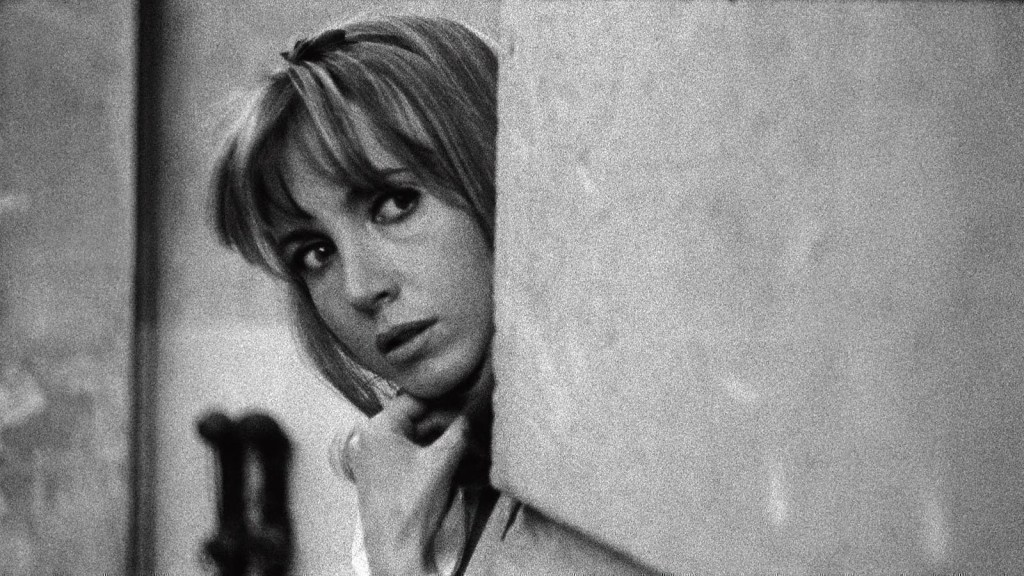
Bulle Ogier
L’amour fou – 1969
The peak of the centre came in 1966 with his play Les Idoles, a highly stylised satirical stage musical starring his workshop pupils Ogier, Clémenti, and Kalfon. Backed by the live rock instrumentation of the band Les Rollsticks, the play parodied the syntheticness of French Ye-Ye and the corporate machinery underneath it and all celebrity worship. He would proceed to adapt this into a feature-length movie, Les Idoles (1968), which was assistant directed by Andre Techine and edited by Jean Eustache.12
The film itself is a cult film. Underseen but rightfully praised. It didn’t do much contemporarily, though Jacques Rivette would later start taking from Marc’O’s troop wholesale for L’amour fou (1969) and most of his subsequent films.
Instead of making new movies, Marc’O took to radical theatre again. He put on radical theatre in Reggio Emilia in early 1968 before heading to Paris in May 1968, where he’d co-found the Revolutionary Committee for Cultural Action (”Comité révolutionnaire d’action culturelle”, or CRAC) with Monique Wittig and Antoinette Fouque.6
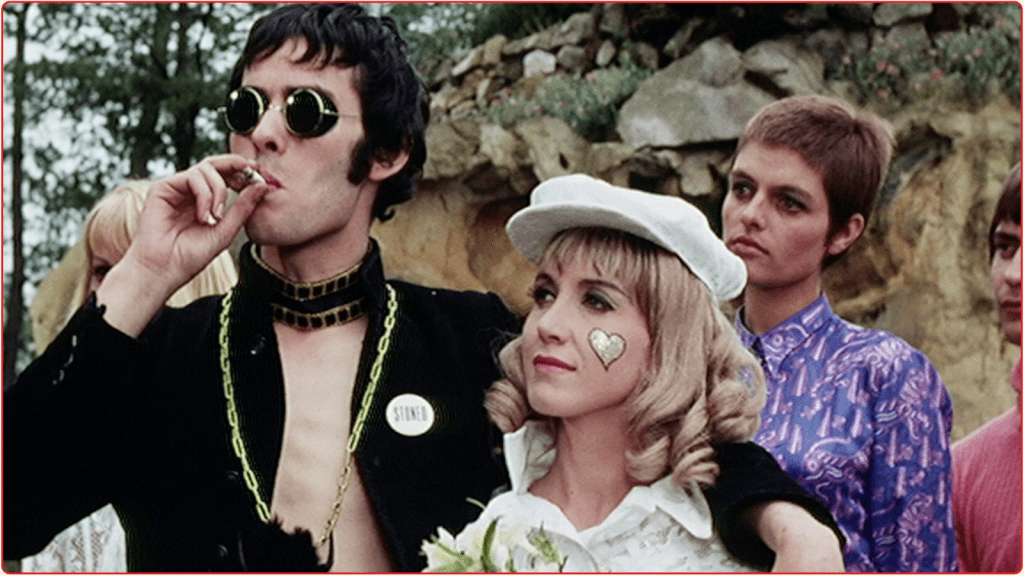
Bulle Ogier and Jean-Pierre Kalfron
Les Idoles – 1968
His post-60s career is barely celebrated in accounts of his career. This makes sense as most of his work was done in radical, immediate cinema, but he remained very busy. He directed Tamaout (1970) with Dominique Issermann about a Moroccan Festival. In 1982, he led Pixigraf, an early initiative to explore digital video synthesis, computer-generated animation and interactive audiovisual experiments. But most of his last 30+ years were spent working with the Laboratory for Practical Studies on Change and with Cristina Bertelli, where he spearheaded the multi-media alternative youth theatre collective Génération Chaos.13
Besides all that, he remained active as a theorist and writer up until his death on 11 June 2025 at the age of 98. Almost certainly the last notable Lettrist and among the last major figures to contribute to 50s cinema at all.14
However, to end on a less depressing note, let’s rewind to 1978, when Stephane Vilar, the composer of Les Idoles, approached Marc’O, who was in Rome with Genevieve Herve, to co-write a project for Vilar’s girlfriend, the famous It girl, Zouzou. They co-wrote a rock opera together, but upon seeing Zouzou’s state (she could hardly hold the microphone), they decided to cast someone else. A friend recommended Catherine Ringer, who, up to this point, was a dancer/musical performer.
Ringer impressed Marc’O, who cast her in their rock opera, Flashes Rouges, which they put on in the theatre from 1978-79. It was Marc’O who introduced Ringer to Fred Chichin, whose father had offered Marc’O a job, thus accidentally launching France’s most important 80s band. Flashes Rouges, sadly, never came to much cinematically. It was filmed on two-inch film, digitally processed, and the master was lost during a move. Yet the excerpts that remain, second/third generation, remain amazing.
References
- “Marc Guillaumin, ancien résistant, chevalier de la Légion d’honneur”
- “Marc’O (Marc-Gilbert Guillaumin, dit, 1927–2025)”
- Serge Berna, 2024 Writings and Documents
- Lettrism, Monoskop
- Marc’O, Notre Cinéma
- Marc’O, Jeune Cinéma
- Nicole Brenez, “The Forms of the Question”, “Millennium Film Journal,
- Lettrist Cinema, Spectacle Theater
- Marc’O, l’acteur autrement, Radio France
- Marion Schmid, Intermedial Dialogues: The French New Wave and Other Arts, 2019
- Yves Lorelle, Chroniques d’un indocile: 1945-81, 2019
- Les Idols, Film Comment
- Le retour de Marc’O, Libération
- Marc O’, auteur, Le Monde
 Bronze Screen Dream
Leave a comment