LIVED
18 October 1923, Athens, Greece – 4 November 1985, Paris
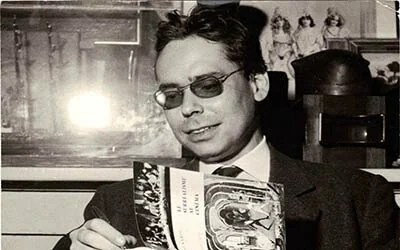
Ado Kyrou was the son of a conservative Athenian newspaper dynasty who joined the communist resistance, was nearly killed for it and fled to Paris in 1945. There he became the most combative Surrealist voice in French film criticism, founding L’Âge du cinéma, writing for Positif and publishing Le Surréalisme au cinéma (1953).
From 1957 he made short films, then returned to Athens for Bloko (1965), a stark film about the German occupation, and adapted Buñuel’s script of Le Moine (1972). He spent his last two decades in television.
SIMILAR FILMMAKERS
Robert Benayoun
Luis Buñuel
Georges Franju
Nelly Kaplan
Nikos Papatakis
Raul Ruiz
START WITH
To Bloko (1965)
Le Moine (1972)
Biography
Adonis Kyrou was born in Athens on 18 October 1923 into a wealthy family of Cypriot origin. His father, Achilleus Kyrou, owned the conservative daily Estia, and Adonis was expected to take it over one day. However, his own tastes ran the other way. As a schoolboy he refused to wear the uniform of the fascist youth movement, and he skipped classes to watch horror films. In Athens he also met the Surrealist poet Andreas Embirikos, his first contact with the movement before studying law at the University of Athens.
During the occupation he joined the Communist Party and its resistance organisation, EAM-ELAS. The party did not trust the son of the Estia family at first and tested him with dangerous errands, such as carrying machine-gun parts on foot across Athens past German patrols. In 1943 he was among the young communists behind the party’s decision to condemn Kitsos Maltezos, a right-wing resistance leader, who was shot in February 1944. In the reprisals that followed, right-wing students and the collaborationist security police attacked Kyrou; he survived thanks to the personal intervention of the prime minister, Ioannis Rallis.
Kyrou left Greece in 1945 on false papers on a British ship, arriving in Paris where he knew no one. He spent the next few years living on a refugee card, working as a dockworker at Les Halles and as a correspondent for a Greek newspaper while he finished a literature degree at the Sorbonne. He also worked as an assistant director to Claude Autant-Lara and Christian-Jaque. He found his way into the Surrealist circle on 11 April 1947, when he was among the hecklers who disrupted Tristan Tzara’s lecture attacking the movement. He became friends with two other young cinephiles, Robert Benayoun and Georges Goldfayn, and André Breton invited him to the group’s meetings at the Café Le Cyrano. He also wrote for the anarchist paper Le Libertaire under the pseudonym Jean Charlaire, since the police watched immigrants who mixed with anarchists.
In March 1951, with Benayoun, Goldfayn and Gérard Legrand, Kyrou founded L’Âge du cinéma, which he directed. It lasted six issues, the best known a Surrealist special to which Breton contributed. In 1953 he published Le Surréalisme au cinéma, which argued that cinema was by nature Surrealist and found that spirit in serials, horror films and melodramas as much as in the avant-garde. The same year, he joined the circle of the magazine Bizarre, around his publisher Éric Losfeld. In 1954 he joined Positif, where for sixteen years he championed Luis Buñuel while attacking Bresson, Cocteau and the critics of Cahiers du cinéma.
Ado Kyrou was among the few Positif critics who tried their hand at filmmaking. La Déroute (1957), with Georges Franju as adviser, mocked the commercial exploitation of the Waterloo battlefield through Victor Hugo’s texts. For Le Palais idéal (1958), the first film about the postman Ferdinand Cheval’s hand-built palace, he had no producer, so he paid for it with a loan from his first wife’s mother. Parfois le dimanche (1960), co-directed with Raoul Sangla and starring Jean-Louis Trintignant, followed a love affair in the industrial suburbs broken up by the Algerian War, and La Chevelure (1960) adapted Maupassant’s tale of a man obsessed with a dead woman’s hair, with Michel Piccoli.
Around 1960 he married Mireille, a composer from Cairo who had studied with Olivier Messiaen and worked at Pierre Schaeffer’s musique concrète studio. She gave up composing for family life, and they had two sons, Ariel in 1962 and Axel in 1964. Kyrou’s book on Buñuel came out in 1962, the year he also returned to Athens to shoot a short, La Paix et la vie. His most celebrated short, Un honnête homme (1964), told the rise of a provincial boy turned Paris criminal entirely through Belle Époque postcards, which he collected; it won the Prix Louis Lumière.
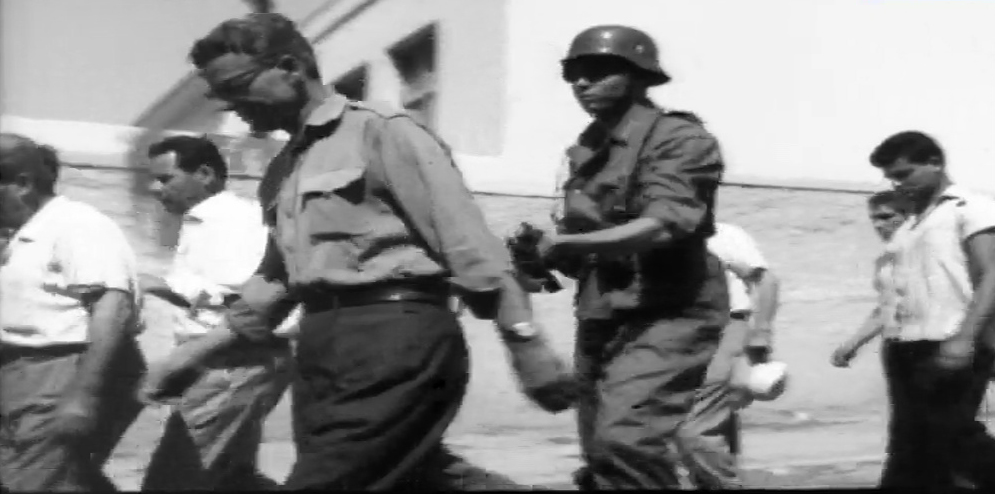
Eventually, he made his first feature, To Bloko (1965), filmed in Greece after censorship relaxed, about the German roundup of August 1944 in Kokkinia, a working-class district of Athens, where hooded collaborators picked out resistance members for execution. Kyrou deliberately made a film without heroes, in which everyone is afraid. It received an honour for direction at Thessaloniki, but audiences stayed away, and critics on both sides attacked it.
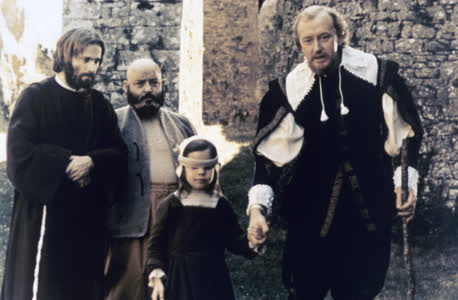
Most of Kyrou’s career was spent directing for TV. From 1968 to 1984, he directed several TV shows like the serial Face aux Lancaster (1971), censored for mocking a policeman, plus documentaries and reports for shows like Aujourd’hui Madame. His last feature, Le Moine (1972), fulfilled an old ambition: he bought from Buñuel the script Buñuel and Jean-Claude Carrière had written from Matthew Lewis’s Gothic novel, and shot it with Franco Nero and Nathalie Delon. It was not a success.
He died in Paris of a ruptured aneurysm on 4 November 1985, aged sixty-two, as the third edition of Le Surréalisme au cinéma was published. He was buried in the Batignolles cemetery, near Breton, the poet Benjamin Péret and Losfeld.
Sources
Ado Kyrou in his own words
- Radio interview, 1980, quoted in Litsa Boudalika, “E is for Interview”
- Le Surréalisme au cinéma (1953; revised 1963, 1985)
- Interview in Max Aub, Conversations with Buñuel
Memoirs and firsthand accounts
- Ariel Kyrou, preface to Le Surréalisme au cinéma (Ramsay, 2005)
- Paul-Louis Thirard and Bernard Chardère, correspondence, Positif, May 1992
- Liner notes, Mireille Kyrou, Étude 1 / Film Musique
Studies
- Ioanna Papaspyridou, “Ado Kyrou, l’éternel révolté”, in Henri Béhar (ed.), Le Cinéma des surréalistes, Mélusine (2004)
- Iason Chandrinos, Η τιμωρός χείρα του λαού (2012)
- André Gerolymatos, Red Acropolis, Black Terror (2004)
- Nikolaos Manitakis, “Mataroa, 1945: The Historical Context”, in Mataroa, 1945: From Myth to History (2018)
- Richard Walter, on L’Âge du cinéma
- Michael Richardson, Surrealism and Film after 1945: Absolutely Modern Mysteries (2021)
- Paul Hammond, The Shadow and Its Shadow: Surrealist Writings on the Cinema (2000)
- Vrasidas Karalis, A History of Greek Cinema (2012)
Period criticism and press
- Louis Seguin, obituary, Positif, December 1985
Reference and records
- “Ado Kyrou”, Répertoire des critiques, historiens et théoriciens du cinéma, Cinémathèque française
Filmography
| Year | Title | English title | Length |
|---|---|---|---|
| 1957 | La Déroute | The Rout | Short |
| 1958 | Porte océane | Short | |
| 1958 | Le Palais idéal | The Ideal Palace | Short |
| 1959 | Le Havre | Short | |
| 1960 | Parfois le dimanche (with Raoul Sangla) | Sometimes on Sunday | Short |
| 1960 | La Chevelure | The Hair | Short |
| 1962 | Le Temps des assassins (with Jean Vigne) | The Time of the Assassins | Short |
| 1962 | La Paix et la vie | Peace and Life | Short |
| 1963 | Les Immortelles | Short | |
| 1964 | Un honnête homme | An Honest Man | Short |
| 1965 | To Bloko | The Roundup | Feature |
| 1969 | Allô police (episode “Au diable la malice”) | Television | |
| 1969 | Sial IV | Television | |
| 1971 | Face aux Lancaster | Television | |
| 1972 | Le Moine | The Monk | Feature |

