Before the French New Wave came along, there was a prior generation of film critics who had been afforded much less attention in criticism. Among that number was Jean-Charles Tacchella, the director of Cousin Cousine, who arrived in Paris in January 1945 and devoured three hundred movies in six months, taking notes on every one.
He talked his way into a job at the brand-new trade paper L’Écran français not long after, and established himself as a core part of the scene, eventually founding Objectif 49. Forty years on, in 1987, Tacchella made a film about exactly that world.
Travelling Avant opens in Paris, October 1948: Nino (Thierry Frémont in a César-winning performance), a rich playboy who’s decided directing might be amusing, falls in with Donald, a serious, unglamorous cinephile fresh from the provinces, and Barbara, who happens to know how to get into a film warehouse. They view the “7th art” not as casual entertainment but as a total lifestyle, and the film tracks their idealistic, logistically frantic and half-criminal (But wholly sincere) attempt to start their own cine-club.
In interviews, Tacchella was adamant this wasn’t autobiographical, claiming he merely scattered personal grains into every character to avoid predictable moralising. Yet, the film’s DNA is undeniably bound to his own history. His 1988 book Les Années éblouissantes, co-authored with Roger Thérond, explicitly chronicles his personal experiences between 1945 and 1952, capturing the exact critical feuds, ideological splits, and ferocious movie-buff culture that define the world of Travelling Avant.
Underneath the heist-like plot is a film about the gap between watching life through other people’s movies and having to live one of your own. Money problems, heartbreak, they all run through film logic. This thematic momentum is baked right into the title itself: a technical French filmmaking term for a “forward tracking shot” or “dolly-in.”
Given Cinema Paradiso was just around the corner, you might’ve assumed this slice of cinema nostalgia would be a hit. Indeed, promo tours of the film were received by packed houses, and the forecast looked good. Then, producer Daniel Toscan du Plantier went against all logic and released it in the dead August lull, and the film was pulled from cinemas within two weeks.
Despite that, it still hit its real audience. Ettore Scola praised its cinematography, and Alexandre Astruc was apparently moved to tears by seeing his lightly fictionalised self on screen.
The shoot itself was as stubborn as its subject. To fake a near-car-free 1948 Paris street, the crew paid to keep fifty parked cars sitting in place for two weeks straight, then cleared the entire block in ten minutes flat the morning they actually shot. And the world premiere wasn’t even in Paris; it was outdoors in Porto-Vecchio, Corsica, hosted by phone, to over a thousand people, by a blind and imperiously elegant Arletty, who afterwards ordered the wine for the cast dinner entirely from memory.
Clearly, Travelling Avant became a film maudit itself. Dead on arrival commercially, invisible online nowadays, but it touched the people it was meant to. That’s, ironically, the afterlife it probably was always going to have. It’s on Prime Video, if you want to find out for yourself.
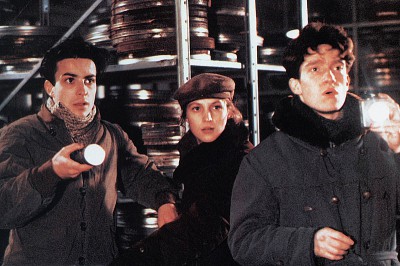
Travelling Avant
1987
Sources
- Les Années éblouissantes, Roger Therond and Jean-Charles Tacchella, 1988
- Words From A Filmmaker, Jean-Charles Tacchella, INA


Leave a Reply