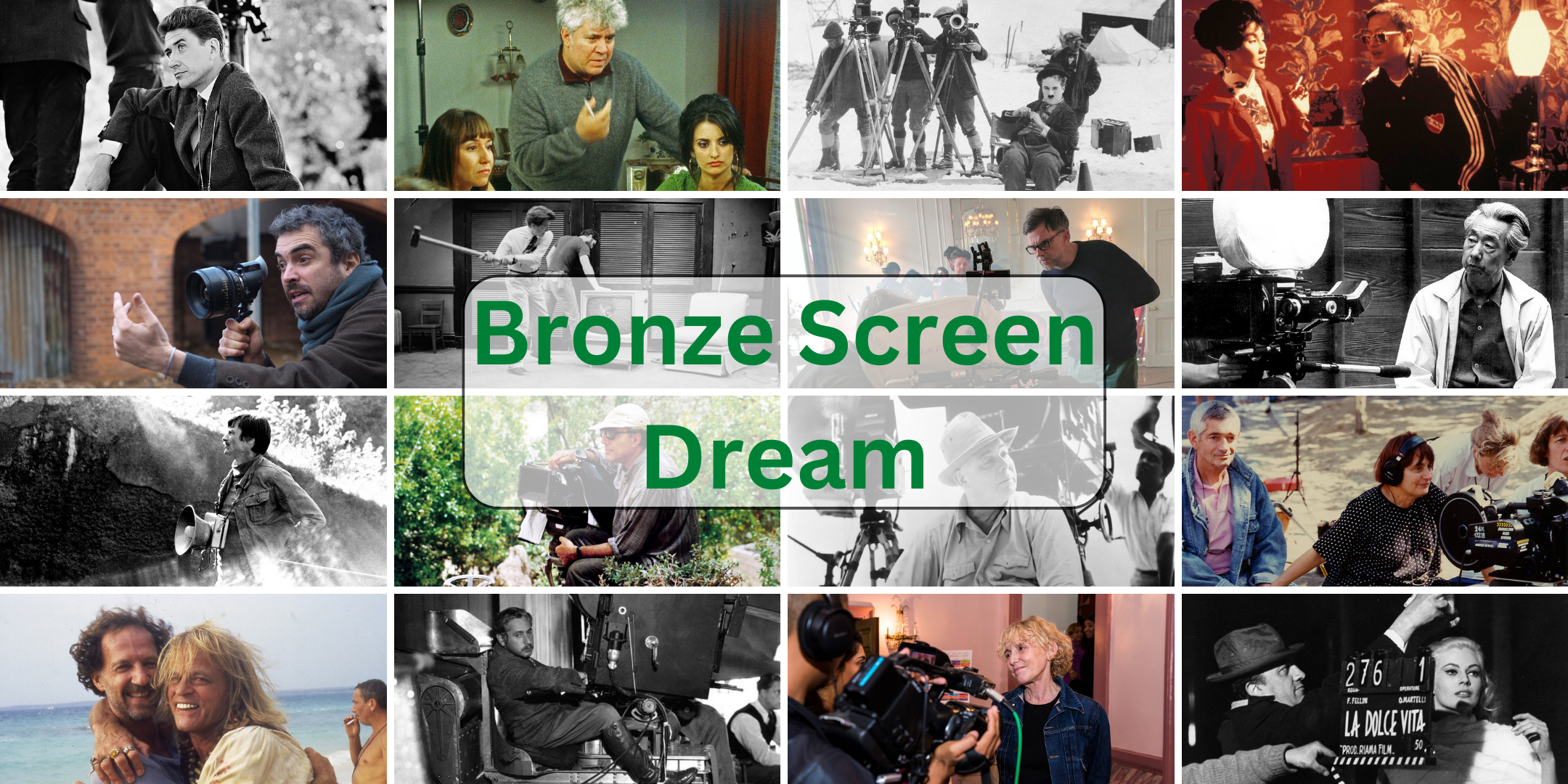
Below are some of the best Tunisian directors ever. Click on their pictures to discover more about them.

A Brief History of Tunisian Cinema
It wasn’t until the 1960s, following Tunisia’s independence from France in 1956, that Tunisian cinema began to develop its own identity. The government established the Tunisian Federation of Film Societies in 1962 and the Carthage Film Festival in 1966, which played a significant role in nurturing the local film industry. This period saw the emergence of films that dealt with issues of national identity, social change, and the challenges of modernisation, often against the backdrop of Tunisia’s rich history and cultural heritage.
Among the notable directors who emerged in this period is Omar Khlifi, often considered the father of Tunisian cinema. His 1966 film “Al-Fahd” (“The Leopard”) was the first Tunisian feature film, marking a significant milestone in the nation’s cinematic history. Another pioneering director is Ferid Boughedir, whose films like “Halfaouine: Child of the Terraces” beautifully depicted Tunisian society and its complexities. The 1980s and 1990s witnessed the rise of female directors such as Moufida Tlatli, whose debut film “The Silences of the Palace” received international acclaim for its portrayal of women’s lives in a patriarchal society.
The turn of the century saw Tunisian cinema expand with directors like Abdellatif Kechiche, whose “The Secret of the Grain” won awards at the Venice Film Festival, and Nouri Bouzid, known for his socially conscious films, have continued the tradition of critical and thoughtful filmmaking. The Tunisian Revolution of 2011 opened up new possibilities and themes for filmmakers, reflecting the changing social and political landscape. Contemporary directors like Kaouther Ben Hania, with her acclaimed film “Beauty and the Dogs”, are pushing the boundaries of domestic cinema.
 Bronze Screen Dream