

Michael Moore is an American documentary filmmaker, author, and political activist widely recognised for his distinctive filmmaking style that explores, critiques, and, at times, satirises American politics, socioeconomic issues, and the healthcare system. Moore’s films are known for their unique blend of humour and pathos, personal narrative, and investigative journalism, as they shed light on systemic issues facing ordinary Americans.
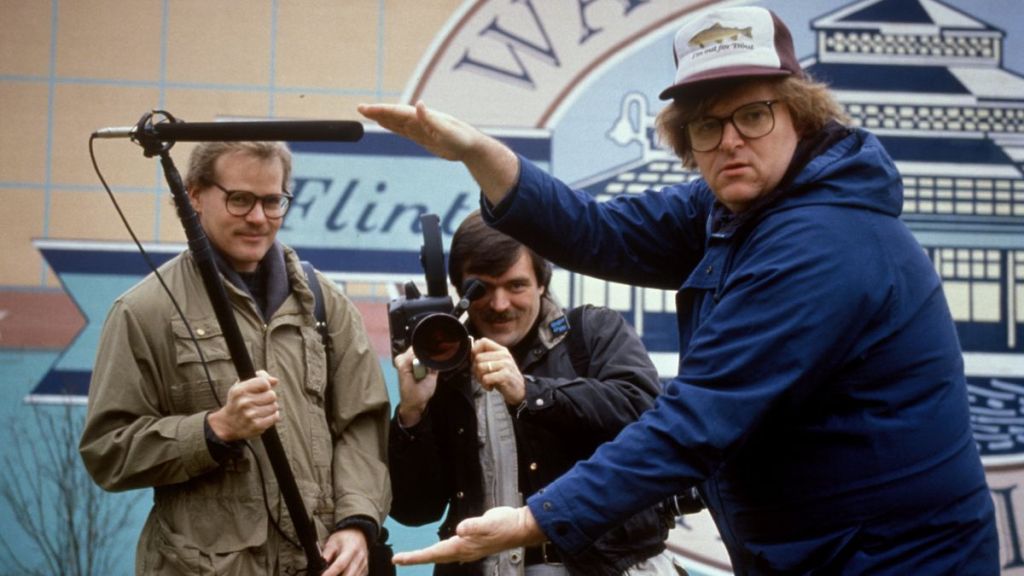
Moore’s filmmaking career began with the groundbreaking Roger & Me in 1989, a documentary that explored the impact of General Motors plant closures in his hometown of Flint, Michigan. This debut set the tone for his career, establishing Moore as a filmmaker unafraid to tackle big issues with a personal and direct approach. Roger & Me was not only a critical success but also a commercial one, heralding the arrival of a major new voice in documentary filmmaking. Over the years, Moore has continued to address controversial topics, with Fahrenheit 9/11, examining the Bush administration’s actions post-9/11, becoming the highest-grossing documentary of all time.
Moore’s filmography is marked by a fearless approach to controversial subjects and a deep commitment to social justice, recurrent themes that stand out across his works. In Bowling for Columbine, for example, he tackles the contentious issue of gun control in the United States, dissecting the nation’s gun culture and its resultant violence through a mix of interviews, archival footage, and Moore’s narrative commentary. Moore often places himself within the narrative of his documentaries, engaging directly with his subjects and audiences to create a more relatable and compelling viewing experience. Furthermore, his work often leverages satirical elements to underscore the absurdity and gravity of the situations portrayed, which is evident in Fahrenheit 9/11, where he critically examines the presidency of George W. Bush and the war on terror.
His films are straightforward but effective, utilising a blend of talking-head interviews, archival footage, and his characteristic “man-on-the-street” interviews to construct persuasive arguments and narratives. His approach often involves asking provocative questions to illuminate the irony or contradiction inherent in the subjects he explores. For instance, in Sicko, Moore embarks on an international exploration of healthcare systems, contrasting the for-profit system in the U.S. with those of other countries, highlighting disparities through personal stories, interviews with experts, and his immersive approach of experiential documentation, ultimately fostering both empathy and critical reflection among viewers.

Michael Moore (1954 – -)
Calculated Films:
- Roger & Me (1989)
- Bowling for Columbine (2002)
- Fahrenheit 9/11 (2004)
Similar Filmmakers
- Alex Gibney
- Amy Berg
- Barbara Kopple
- D.A. Pennebaker
- Davis Guggenheim
- Errol Morris
- Eugene Jarecki
- Frederick Wiseman
- Joe Berlinger
- Josh Fox
- Kazuo Hara
- Ken Burns
- Laura Poitras
- Morgan Spurlock
- Nick Broomfield
- Oliver Stone
- Robert Greenwald
- Steve James



Michael Moore’s Top 5 Films Ranked
1. Sicko (2007)
Genre: Political Documentary, Investigative Documentary

2. Bowling for Columbine (2002)
Genre: Political Documentary, Investigative Documentary

3. Roger & Me (1989)
Genre: Political Documentary
4. Fahrenheit 9/11 (2004)
Genre: Political Documentary

5. Where to Invade Next (2015)
Genre: Political Documentary

Michael Moore: Themes and Style
Themes:
- Social Critique: Moore is famous for his scathing commentary on various aspects of American society, whether it’s healthcare in Sicko, gun control in Bowling for Columbine, or the financial crisis in Capitalism: A Love Story.
- Political Commentary: From examining the Bush administration in Fahrenheit 9/11 to the Flint water crisis in Fahrenheit 11/9, Moore is deeply engaged with the political landscape, often presenting a leftist perspective.
- Corporate Greed: Films like Roger & Me and Capitalism: A Love Story examines the consequences of corporate actions on everyday Americans, highlighting the disparity between the wealthy elite and the working class.
- Everyday Heroes: Moore often champions the ordinary individuals who stand up against big corporations or government entities, showcasing their resilience and strength.
Styles:
- Documentary Format: Most of Moore’s films are documentaries, employing a combination of interviews, archival footage, and on-the-spot recordings.
- Satire and Humor: Even in addressing grave issues, Moore’s films often incorporate wit and sarcasm to drive home their messages and make them accessible.
- Personal Involvement: Moore often places himself at the centre of his films, interacting with subjects, confronting authorities, or providing narration, thereby making his presence felt and guiding the viewer’s perspective.
- Montages: He uses creative montages, usually juxtaposing contrasting imagery with music or narration to make a point.
- Emotionally Charged Scenes: Moore is known for creating sequences that evoke strong emotions, whether it’s the heart-wrenching testimony of a victim or the absurdity of a bureaucratic system.
Directorial Signature:
- Gonzo Approach: Moore’s style can be termed as “gonzo journalism” in the world of filmmaking. He’s often an active participant in his films, using his personal experiences and emotions to shape the narrative.
- Provocative Questions: Moore often asks challenging, direct questions to authorities, corporations, or interview subjects, aiming to elicit revealing or uncomfortable responses.
- Pop Culture References: Moore seamlessly integrates pop culture into his documentaries, making them both relevant and relatable to a broader audience.
- Voiceovers: His films frequently feature his distinctive voice, providing commentary, background information, or personal reflections, helping guide the narrative and offer context.
- Visual Metaphors: Moore employs strong visual metaphors that simplify complex issues. For instance, in Bowling for Columbine, he uses the animation segment “A Brief History of the United States of America” to satirically depict America’s history of violence.
Michael Moore – Great Director




 Bronze Screen Dream