
Jacques Tati made six feature films across thirty years and nearly bankrupted himself making the most ambitious one, which tells you most of what you need to know about him. Playtime cost so much, took so long, and required such an unprecedented physical production (an entire fake modernist Paris built on the outskirts of the real one) that its commercial failure left him without the rights to his own work for years. He knew what he was doing, and he did it anyway, which is either madness or integrity and is probably both.
He came up through music hall and mime, and the body never stopped being his primary instrument. His Hulot walk, that particular combination of forward lean and trailing raincoat, is one of the most recognisable physical signatures in cinema. But calling him a physical comedian undersells what he was actually doing. The gags in a Tati film are distributed across the entire frame, happening simultaneously at different depths, and you choose where to look. In Playtime especially, Hulot is sometimes almost invisible, a figure among hundreds, and the film works better for it.
The subject across almost the entire career is modernisation; the glass and steel and efficiency of postwar France, consuming the older, more human-scaled world. Mon Oncle makes this explicit and warm, Playtime makes it architectural and then, quietly, hopeful as the film ends with Paris reorganising itself into something human despite everything. That final sequence in the traffic roundabout is one of cinema’s great acts of optimism about people.
He was also, technically, one of the most innovative sound designers in French cinema, which doesn’t get said enough. The soundscapes of his films are as meticulous as the images, and as funny.
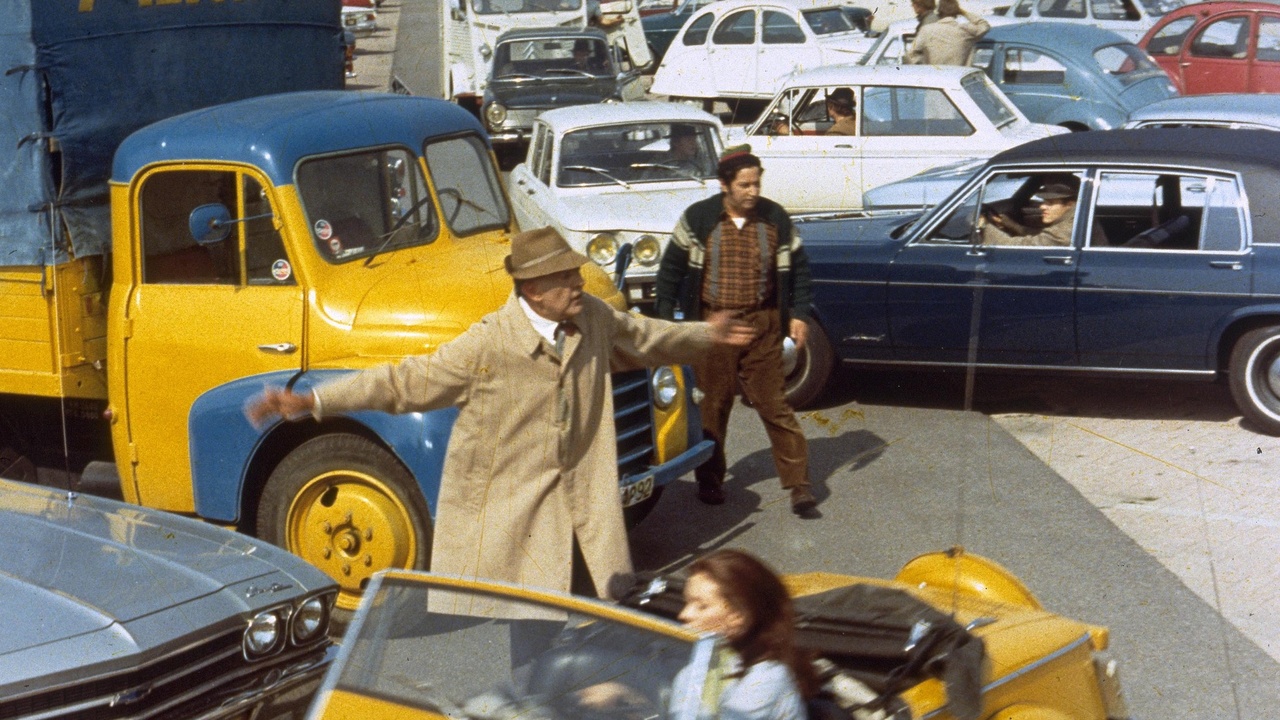

Jacques Tati (1907 – 1982)
- 1947 – L’École des facteurs
- 1948 – Jour de Fete
- 1953 – Mr Hulot’s Holiday
- 1958 – Mon Oncle
- 1967 – Playtime
- 1971 – Traffic
- 1974 – Parade
- Modernisation as Comedy and Elegy: Tati’s films are simultaneously funny about and sad about the modernisation of France. The comedy comes from the gap between what modernity promises and what it delivers; the elegy comes from what it displaces.
- The Democracy of the Frame: Where classical cinema uses close-ups to direct attention, Tati uses wide shots that present multiple simultaneous events and invite the viewer to choose. This is a formal position about the equality of things in the world.
- Sound as Comedy: The soundscapes are as composed as the images: squeaking doors, echoing footsteps, the particular noise of modern materials. Tati understood that sound is always doing something and designed his films’ auditory world with the same precision as the visual. The sound gags are as good as the sight gags.
- Hulot as Witness Rather Than Protagonist: The recurring character doesn’t drive the films’ plots so much as move through them, observing. In Playtime, he’s barely the protagonist at all — he’s an excuse for the camera to be in a place where things are happening. The choice to diminish the central character is the film’s argument about individualism.
- Architecture as Character: Tati’s films exist in a living setting. His environments are never the background; they’re the subject. The Arpel house in Mon Oncle, the glass towers of Playtime, the motorway infrastructure of Trafic all have personalities and agendas, and the comedy emerges from the conflict between human behaviour and architectural intention.
- Aki Kaurismäki
- Bent Hamer
- Buster Keaton
- Charlie Chaplin
- Elia Suleiman
- Jerry Lewis
- Pierre Etaix
- Rene Clair
- Roy Andersson
- Wes Anderson
Biography
Coming soon

