
Jacques Demy made films about people who miss each other by minutes, who arrive too late or leave too early, whose lives would have been entirely different if fate had arranged things slightly otherwise. That’s the emotional engine underneath the colours and the songs; a tenderness toward the unlucky, toward the person who got the wrong ending.
His debut, Lola (1961), shot in black and white, established his register: Port towns, women waiting, the possibility that love lost might return. Lola, played by Anouk Aimée, will reappear later in Model Shop, his failed Hollywood transition, which gives his filmography a peculiar continuity.
Les Parapluies de Cherbourg, in 1964, is the film that made him internationally famous and remains one of the genuinely strange achievements of French cinema, a love story in which every word is sung, not in the American musical tradition of characters bursting into song, but continuously, recitative and aria indistinguishable, the everyday made operatic by Michel Legrand’s score and the extraordinary audacity of the decision. The Palme d’Or was the right call. It should not work as well as it does.
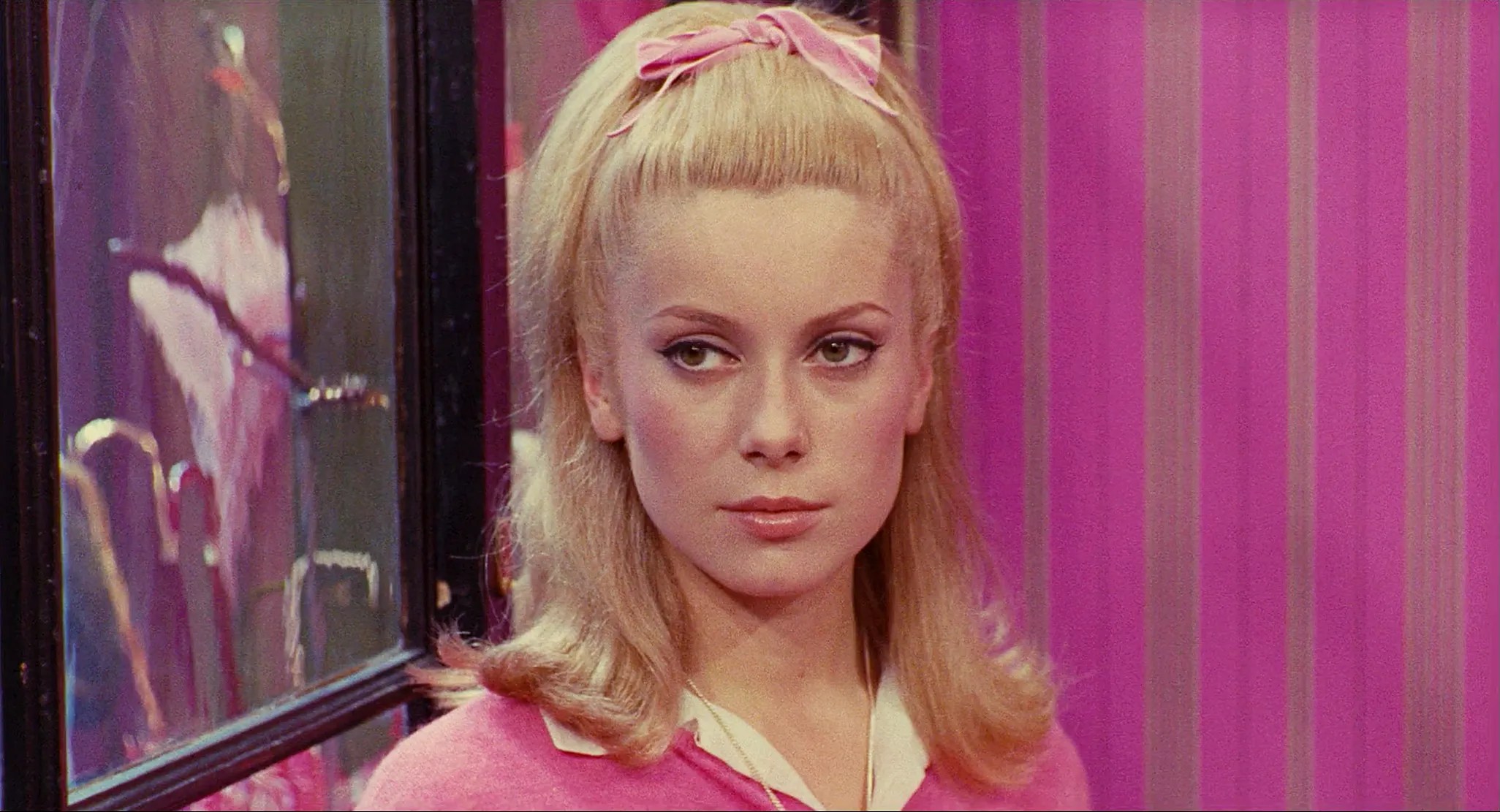
Les Demoiselles de Rochefort, three years later, is the sunnier twin, Deneuve and her sister Françoise Dorléac, Gene Kelly imported from Hollywood, the town repainted in pastel, and then Peau d’Âne turns toward a fairy tale. The later career has underrated films, but the 1961-70 run is the essential Demy and one of the most distinctive decades any French director produced.

Jacques Demy (1931 – 1990)
- 1956 – The Clog Maker of the Loire Valley
- 1957 – Le bel indifferent
- 1959 – Ars
- 1961 – Lola
- 1963 – Bay of Angels
- 1964 – The Umbrellas of Cherbourg
- 1967 – The Young Girls of Rochefort
- 1969 – Model Shop
- 1970 – Donkey Skin
- 1972 – The Pied Piper
- 1973 – A Slightly Pregnant Man
- 1979 – Lady Oscar
- 1982 – A Room in Town
- 1985 – Parking
- 1988 – The Turntable
- 1988 – Three Seats for the 26th
- Romantic Fatalism and the Near Miss: Demy’s films are built around the tragedy of timing: two people who might have been happy together, separated by circumstance. This reappears constantly: Lola, Umbrellas of Cherbourg, Model Shop, even Une Chambre de Ville, his late masterpiece, features a class-warfare-laden longing in the shape of Francois and Edith.
- The Shared Universe as Mythology: Characters from Lola reappear in Les Parapluies de Cherbourg, in Model Shop, in Une Chambre en Ville, not as fan service but as a genuine attempt to create a fictional world with the continuity of a real one. The Atlantic coast towns of his childhood become a mythological space where the same people keep almost finding each other.
- The Legrand Collaboration: Most of Demy’s films feature Michel Legrand scores, which contain the films’ whole emotional structure: Umbrellas of Cherbourg’s sing-talking transforms a love story into something closer to opera. This only works because Legrand understood exactly what Demy was reaching for.
- Colour as Emotional Register: The saturated palettes of Les Demoiselles de Rochefort and Peau d’Âne aren’t decorative; they’re the visual equivalent of the musical form, a heightening that signals you are in a world operating at a different emotional pitch than realism. The colour in Demy is aspirational; it’s what happiness looks like from the outside.
- The Hollywood Musical Transformed: Demy grew up on Minnelli and Donen and took the American musical form seriously enough to do something genuinely different with it; importing it into French provincial reality, removing the fantasy of the happy ending, insisting that the sung emotion be the real emotion of characters in actual circumstances. It’s not pastiche or homage but transformation, which is why the films survive their influences.
Biography
Coming soon

