
When Nikita Mikhalkov isn’t busy towing the Kremlin line, he’s usually out there making movies. Mikhalkov is one of the most important Russian directors since the 1970s and has been heavily involved in the Soviet film industry since the 1960s. However, his general output hasn’t been too consistent over the years.
Russian cinema is an often overlooked aspect of global cinema. I’m not sure why. I think the closest parallel you can find to it is German cinema. Both were instrumental in the development of the medium, and both are defined by their major directors more than the industry itself. When we think of German movies, we think of Herzog, Murnau, and Ophuls; when we think of Russian cinema, we think of Eisenstein, Tarkovsky, and… well, that’s about it.
However, this results in many directors being unfairly misrepresented. Ignoring Mikhalkov’s current actions, he’s a director with lots to applaud. So, I thought, today being his 78th birthday, we should highlight a few of his films today and try to point you in the direction of his movies.
An Unfinished Piece for Player Piano

An Unfinished Piece for Player Piano (or “Неоконченная пьеса для механического пианино” in Russian) is a 1977 film based on a play by Anton Chekhov; this is arguably one of the best adaptations of the playwright’s work to grace the silver screen.
Set during a summer day on a country estate, the story revolves around a series of intertwined relationships, unspoken desires, and lingering regrets. The characters are meticulously fleshed out, mirroring the complexities of real-life individuals. Chekhov’s distinct narrative style, characterized by its examination of the subtleties of human emotions and the impermanence of life, finds a perfect conduit in Mikhalkov’s direction.
What stands out in An Unfinished Piece for Player Piano is Mikhalkov’s ability to extract incredible performances from his ensemble cast. The characters are trapped in their societal roles, yet the nuances in their interactions and dialogues reveal deep-seated emotional conflicts. There’s an undeniable layer of melancholy that permeates the film, but it’s balanced with moments of humor and warmth, echoing Chekhov’s unique blend of tragedy and comedy.
Visually, the movie is a delight. The cinematography captures the beauty of the Russian countryside, with its vast landscapes acting as a backdrop to the human drama unfolding in the foreground. The serene ambiance contrasts sharply with the emotional turmoil of the characters, making the narrative even more poignant. It’s closer to a novel than a flash film. Each frame, each dialogue, and each character arc are intricately woven, revealing layers of meaning as the story unfolds.
- UK: NA
- US: Kanopy
- France: NA
- Brazil: NA
- India: NA
- Germany: NA
Generally, the film isn’t too widely available. However, MosFilm has made the film accessible on YouTube here.
Dark Eyes

Another Chekhov drama Mikhaklov made is Dark Eyes. The story revolves around Romano, played by Marcello Mastroianni, who reflects on a life full of missed opportunities and dreams. Mastroianni’s portrayal of a man trapped by his own choices and a prisoner of his past is heartbreakingly real, earning him the Best Actor award at the Cannes Film Festival. Apart from Mastroianni’s standout performance, the film boasts of a stellar European cast, including Silvana Mangano, Marthe Keller, and Yelena Safonova.
Mikhalkov employs a melancholic, almost dreamy visual style that beautifully captures the essence of Chekhov’s world. The film weaves in and out of the present and past, offering us a layered narrative that delves deep into human emotions, regrets, and the idea of what could have been. The picturesque Italian and Russian landscapes serve as a reflection of Romano’s inner turmoil and lost love.
The director has always been known to tackle broad themes with a personal touch, and here is no different. Dark Eyes deals with aging, the passing of time, and the weight of decisions. It questions the very essence of love, fidelity, and desire.
- UK: Rentable on Amazon
- US: Rentable on Amazon
- France: Amazon Prime
- Brazil: NA
- India: NA
- Germany: Amazon Prime
Burnt By The Sun
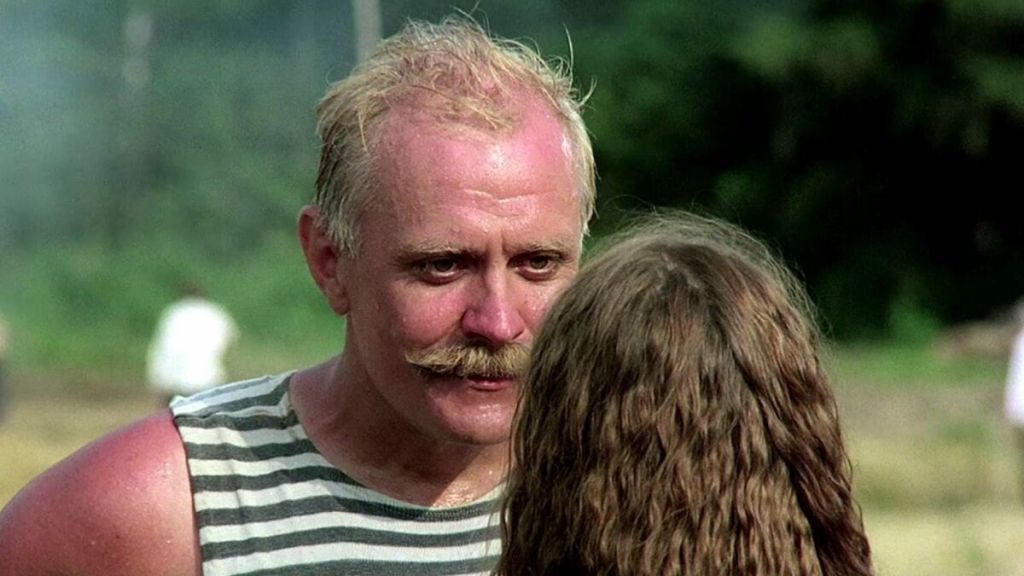
Mikhalkov made a pretty atrocious sequel to this 1994 drama in 2011, which would be a bit like if Christopher Nolan followed up The Dark Knight with Batman & Robin. The awful, plodding, poorly acted, cheap-feeling film is a shadow of the original work. Still, its shallowness doesn’t degrade the first film, a powerful tale of love, betrayal, and the dark shadows cast by Stalinist purges in the Soviet Union.
Set in the tumultuous 1930s, the narrative revolves around the life of a decorated Red Army officer, Colonel Sergei Petrovich Kotov, who is spending a serene summer day with his young family. The tranquil setting is disrupted by the sudden arrival of Mitya, a former lover of Kotov’s wife and an old friend of the family. However, Mitya’s return hides a sinister agenda linked to the looming political terror, and the tale quickly unravels into a deeply moving tragedy, exposing the terrifying scope of Stalin’s purges.
Mikhalkov himself takes on the role of Colonel Kotov, delivering a powerful performance that beautifully contrasts the love he has for his family with the creeping dread as he realizes the truth about Mitya’s visit. The character of Mitya, played by Oleg Menshikov, is complex and multi-dimensional, embodying both the trauma of betrayal and the weight of serving a tyrannical regime.
What makes Burnt By The Sun stand out, aside from its masterful storytelling, is its exquisite portrayal of the pre-purge Soviet Union. Mikhalkov deftly juxtaposes the idyllic countryside setting with the political horrors of the time, making the eventual downfall all the more heart-wrenching.
The film’s haunting score, composed by Eduard Artemyev, adds another layer of emotion, resonating with the underlying themes of love, treachery, and despair. It’s no surprise that the film went on to win the Palme d’Or at Cannes and the Oscar for Best Foreign Language Film.
- UK: NA
- US: Rentable on Amazon & other sites
- France: Rentable on LaCinetek
- Brazil: NA
- India: NA
- Germany: Mubi
 Bronze Screen Dream