

I’ve been quite busy pushing out these latest director additions. I think this bunch is quite eclectic. On the one hand, historically important figures rarely get the respect their influence deserves (Pudovkin & Wiene). There’s a classic figure who doesn’t neatly fit the director’s mould (Kelly), and we finish it off with two polar opposite modern masters. One is the heartbeat of the Romanian New Wave and a beloved auteur (Mungiu), and the other is an eclectic, unpredictable Japanese master whose every film is a coin flip between masterpiece and mishap.

Vsevolod Pudovkin
Russia 🇷🇺 | 1893 – 1953 | Early Soviet Cinema
When we think about other Soviet cinema, we usually think about Sergei Eisenstein and a select few others. If modern cinema had four starting points, those are in the backlots of D.W. Griffith’s productions, in the German Expressionist’s studios, in Melies’ magical experiments and in the editing chambers of the Soviet montagists. Depending on how deep in the well of movies you are, some might sound familiar to you, like Dziga Vertov, Eisenstein… etc. But someone often not mentioned is Vsevolod Pudovkin, one of the original Soviet montagists.
Pudovkin isn’t the most obvious candidate for a profile. He certainly isn’t so well-known he needs one; his historical importance is only really obvious through influence, and his best film, you must admit, isn’t a total standout. He’s not an easy pick, but one of my goals with the profile selection is trying to represent cinema. The simple fact is that we Westerners don’t give as much attention to Soviet cinema, and Pudovkin, even without the filmography of Eisenstein, did as much as he did to craft the movement.
While Eisenstein dissected montage to shape the audience’s emotions, Pudovkin wove it more intimately, considering the impact of each shot and its relation to the next. Unsurprisingly, Pudovkin’s treatise on film technique remains a fundamental text for film scholars and students.
Consider his masterwork, Mother. While other directors used the October Revolution as a vast canvas, Pudovkin distils the essence of revolution through a woman’s personal, intimate journey. His ability to interlace the individual with the political was distinctive in the USSR.
His films often swayed between the epic and the intimate. In The End of St. Petersburg, he painted a vivid picture of a city in flux, revolution and change sweeping through its cobbled streets. In Deserter, he explored a German worker’s personal and ideological struggles during the Weimar Republic, never letting the individual get lost in the tides of political turmoil.
Yet, Pudovkin isn’t Eisenstein. He isn’t as important. He didn’t make half as many, half as good, works. But his importance to his contemporaries is undeniable. He was the unloved mule who dragged cinema in a new direction.
Nowadays, with montage appearing in every facet of visual art, Pudovkin’s teachings remain as pertinent as ever. But he remains obscure, waiting for rediscovery, waiting to be given his respect.
Robert Wiene
Germany 🇩🇪 | 1873 – 1938 | German Expressionism
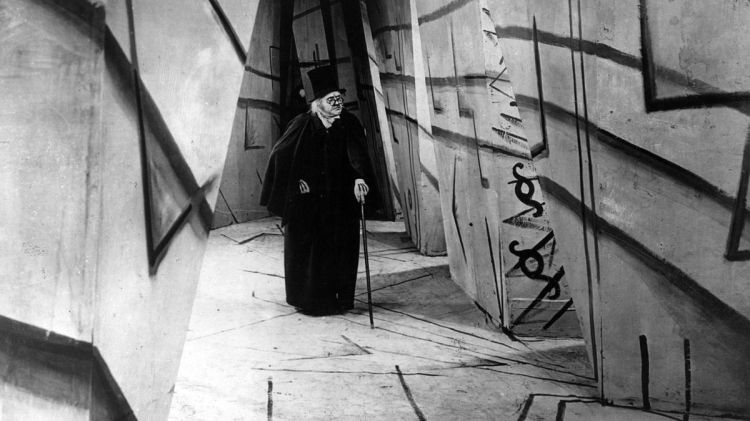
Talking about unsung masters of important movements, we move on to Robert Wiene, almost the perfect counterpoint to Vsevollod Pudovkin. He is similarly overshadowed by his larger contemporaries. His whole work was influenced by his like Fritz Lang and F.W. Murnau. Yet, unlike Pudovkin, Wiene has an undeniably brilliant film that has more than stood the test of time. The Cabinet of Dr. Caligari, with its eerie landscapes and evocative narrative, captured German post-WWI anxiety. Wiene command over the visual medium manifested in his ability to translate abstract thought into the stark, otherworldly architecture of his films.
Yet, where he truly captivated was not merely in the visual but in his nuanced understanding of human frailty and madness. For all its aesthetic triumphs, Caligari is most deeply remembered for the twist, the shocking unravelling of reality, casting doubt on all that preceded it. It’s a bold commentary on trauma and perception that remains relevant today.
Wiene is an odd one. Paradoxically, his work is revered while the man isn’t. Unlike Pudovkin, he doesn’t even get much credit from cinephiles. His influence isn’t that apparent, and even his masterpiece’s significance has been downplayed by people who claim German expressionism was already a thing, thus suggesting it had minimal influence. Stupid, of course, but Wiene never had anyone to defend his honour, no one to revere his importance. He died before WW2, before the serious reappraisal of the movement, and with just one major film.
I doubt Wiene will ever be seriously reassessed as a major director. He simply doesn’t have the catalogue for it. Nor is he a standout figure in the movement; instead, he just happened to create the best film of it.
But he’s still worth remembering. To understand Wiene is to embrace the shadows, peer into the abyss of the human soul, and recognise that amidst the stark contrasts of his work, there exists a grey – a murkiness of emotion and intent that is both challenging and deeply rewarding.

Gene Kelly
United States of America 🇺🇸 | 1912 – 1996 | Golden Age Musicals
One of the major problems I first encountered when making this site was what to do with duos and, more than that, what to do with teams where one partner enjoyed a more prominent directing career. You have modern cases like the Coens, where they’ve recently started making individual films, but their legacy is generally cemented by their career together.
The two most obvious cases I had to deal with were The Archers and Donen and Kelly. With The Archers, it wasn’t that hard; Powell was the main director of the two, and he directed films independently, so it made sense to credit him. Doing so does somewhat discredit Emeric Pressburger, whose contributions should be noted. But chucking him in at the same place as his partner suggests that none of Powell’s solo work is worth watching.
It’s tricky, but in that case, I decided to give the place to Powell and promise to make a separate one for Pressburger one day, although that day is still in the distant future.
Stanley Donen and Gene Kelly were a trickier case. Both had decent careers independent of one another, but most of Kelly’s directing success came with Donen; while Donen’s best was with Kelly, he had more individual hits. Thus, I made one for Donen, who had a better directorial career, but in doing so, you end up dismissing Kelly’s directing talents.
It’ll always be a subject of debate: who did what, who was more important. Kelly was the senior member of the duo. Donen’s later success seems to validate that he was a major creative force in it, but to what degree remains ambiguous, which is why I wanted to rectify my decision quickly.
Labelling Kelly as simply a dancing star would be an egregious oversight. Beyond the nimble footwork and charismatic screen presence, Kelly’s vision transformed the classic movie musical.
While iconic sequences from Singin’ in the Rain can make anyone’s heart skip a beat, diving deeper into Kelly’s directorial finesse is essential. His collaborations with Donen gave rise to some of the most innovative moments in the musical genre. Together, they defied gravity in both dreamy and audacious sequences, most memorably in the surreal “You Were Meant For Me” scene, where the environment seamlessly dances with the performers.
Kelly believed every dance number should emerge organically from the plot, ensuring the narrative’s flow remained uninterrupted. This broke musicals free from the traditionally shoehorned set pieces of earlier musicals, making his films feel cohesive and immersive.
In a world that idolised Fred Astaire’s elegance, Kelly brought a robust, everyman appeal to dance. His characters were relatable, their stories grounded. As a director, he captured these tales with an authenticity that resonated with the working-class hero, making dreams feel tangible and dancing as an expression of joy everyone could partake in.
He might not have had the success Donen would enjoy once their partnership broke apart, but dismissing Kelly as the lesser partner would be an injustice.

Cristian Mungiu
Romania 🇷🇴 | 1968 – – | Romanian New Wave
How about something a bit more modern? At the heart of Romania’s cinematic renaissance, we find Cristian Mungiu. Who has emerged from the New Wave with a raw, incisive realism that carved a space for Romanian cinema on the world stage. Those familiar with his 4 Months, 3 Weeks and 2 Days will attest to Mungiu’s uncompromising ability to depict post-communist life in its stark, unvarnished reality.
Mungiu’s style is elegantly understated, favouring long takes and naturalism. Unlike his contemporaries, who often get ensnared in the seduction of polished visuals, Mungiu remains rooted in the essence of storytelling. His tales often gravitate towards societal taboos, family strife, and moral ambiguities, revealing a nation’s transition scars.
For example, Beyond the Hills meticulously unravels the tensions between tradition and modernity, faith and reason, in a tragic story based on real events. Here, Mungiu’s cinematic palette is at its finest – nuanced performances, evocative landscapes, and a narrative rhythm in no hurry, allowing the viewer to absorb every emotional layer.
Mingiu is a pretty well-regarded figure in modern art cinema. His films get the credit they deserve from festivals, but as you’d expect, he’s not a household name. Many claim the New Wave has waned, but Mungiu remains a bastion of its spirit. His dedication to authentic representation and the human condition is unwavering.

Takashi Miike
Japan 🇯🇵 | 1960 – – | Japanese Contemporary Cinema
Sion Sono and Takashi Miike are the two enfant terribles of Japanese cinema. Both are incredibly prolific, and both work in almost every genre. Miike has dabbled in every conceivable genre, from ultra-violent yakuza films to heartwarming family dramas. But Sono sits in the top 250 directors while Miike flounders elsewhere. What’s the difference? I suppose it is because Miike doesn’t have that one universally acclaimed work. Yeah, he has some incredible films like the harrowing Audition and the psychedelic gore-fest Ichi the Killer.” Still, he’s never been easy to pigeonhole, while rarely helps an auteur’s reputation.
His vast filmography is like an eclectic tapestry, threading the weird, the wonderful, and often the downright inexplicable. Miike never panders; he crafts his narratives with an intensity that’s as captivating as it is disconcerting.
13 Assassins is a good example. On its surface, it is a samurai epic, but look deeper, it’s a contemplation on the nature of violence and honour, a recalibration of the classic chambara film that Kurosawa might have been both perplexed and proud of. Or take Yakuza Apocalypse, which only Miike could dream up, where traditional gangster tropes are tossed into a bizarre blender with vampire mythology, martial arts, and a hint of post-modern madness.
What’s particularly intriguing about Miike is his chameleon-like ability to shift tones seamlessly. One moment, you’re lulled into a quiet, contemplative scene, and the next, you’re thrust into a maelstrom of chaos that defies all cinematic conventions.
Miike will never be a universally beloved figure. His work will never let him transcend the fringes of cinema. Is it his refusal to conform? Is it the sheer unpredictability that his films exude, often challenging the viewer’s notion of cinema? Or is it just the insurmountable challenge of categorising a director who resists every label?
 Bronze Screen Dream