Stan Brakhage
United States of America 🇺🇸 | 1933 – 2003 | Experimental Cinema
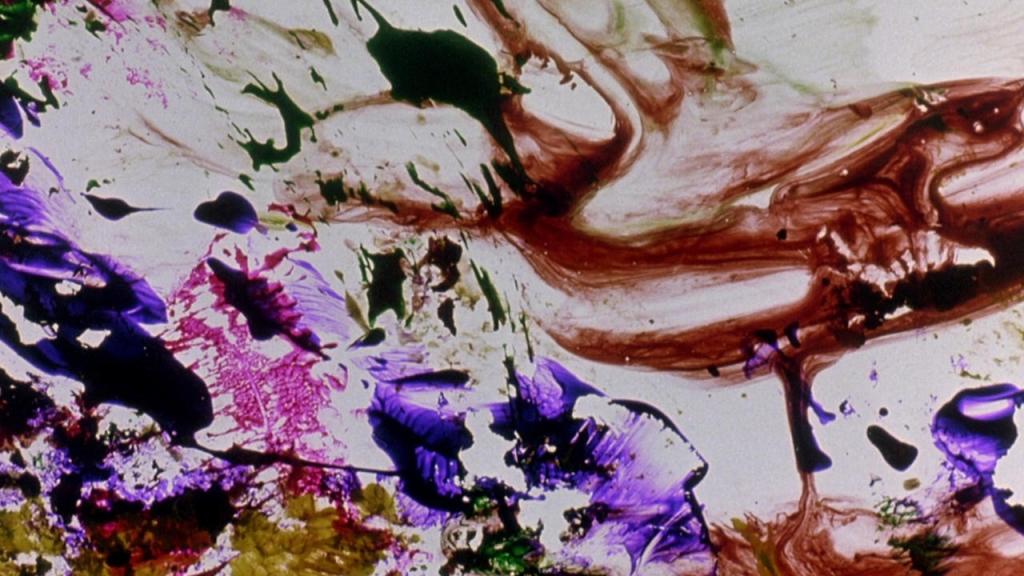
Stan Brakhage is a tricky, tricky character. He is one of the most important filmmakers few people have ever watched. His films, if you can even label them as such, are experiences – sequences of light, colour, and texture that defy conventional understanding. While his contemporaries might have been satisfied with capturing reality, Brakhage was striving to depict the act of seeing itself, as evident in his masterpiece, Dog Star Man. Hand-painting film strips, using moth wings or medical footage, he wasn’t just a director; he was a visceral artist.
Check out Brakhage’s 1963 short film Mothlight and observe a world where the boundaries of narrative dissolve, replaced with images created by pressing moth wings and plant leaves between two strips of film. It’s a symphony of organic randomness and deliberate craftsmanship, capturing life’s fleeting nature in a way words could never encompass.
Critics and audiences might struggle to understand or even appreciate his work fully, but the depth of his influence is unmistakable. Experimental filmmakers and artists like Bill Viola or Godfrey Reggio owe much to Brakhage’s audacity and willingness to redefine cinema.
It’s not a surprise Brakhage remains on the fringes of the wider cinephile discussions. The esoteric nature of his films and his blatant anti-mainstream works make him a hard nut to crack. But if you’re considering diving into the avant-garde, you should check him out; he is, after all, the crown prince of American experimental filmmaking.

Georges Méliès
France 🇫🇷 | 1861 – 1938 | The Grandfather of all Filmmakers
I wasn’t sure if I should make a profile for Georges Méliès. His works are hardly watched recreationally; they are studied. His entire filmography also sits outside of time and space. He did it so long ago and has touched everything since then that watching them can never quite reflect their importance.
He’s a bit like D.W. Griffith in that way. But he’s even more pioneering than him. At least Griffith worked with other great directors and had that direct link. Méliès toiled away in his studio and then vanished into thin air. So, making a profile about him felt odd, but the completionist within me knew that without Méliès, this site was incomplete. So, we delve into the Frenchman’s work.
A conjurer by profession and craft, Méliès took the fledgling medium of film and doused it in the waters of magic and fantasy. When everyone else was still playing with moving images as a mere novelty, Méliès had already envisioned and executed cinema as the ultimate stage for enchantment.
A Trip to the Moon (1902) is undoubtedly his most iconic work. That image of the Man in the Moon, poked in the eye by a rocket ship, is emblematic of his playfully imaginative approach and a testament to his undeniable influence. But don’t be deceived — behind those theatrical sets and whimsical costumes lay a filmmaker decades ahead of his time, experimenting with special effects, multiple exposures, and time-lapse photography.
It’s not just about the tricks for Méliès, though. His films, while otherworldly and fantastical, carried the spirit and heartbeat of the stage — the grandiosity, the drama, and the sheer theatricality. He was an artist who never let technology lead him; instead, he bent it to his will, making it dance to his tunes of dreamy narratives.
Today, every time a filmmaker dabbles in the extraordinary or crafts a scene that leaves audiences awestruck, there’s a bit of Méliès in there. Though set in the silent era, his star still twinkles, reminding us of the boundless possibilities of imagination when melded with the reel. So, next time you see a movie magic moment, tip your hat to the grand sorcerer of cinema, Georges Méliès. Because somewhere, behind the veil of time, he’s still crafting those magical moments.

Jafar Panahi
Iran 🇮🇷 | 1960 – – | The Iranian New Wave’s Child
The only reason it’s taken this long to add a profile for Jafar Panahi is that his films haven’t quite yet broken him into the top 250 rankings. Instead, he sits at 292 on my overall list. Panahi has been the ultimate symbol of resilience and creativity amidst oppressive confines. The Iranian filmmaker doesn’t just make movies. He makes something so much grander. His dedication to the medium is nothing short of inspiring.
From his early works like The White Balloon to the groundbreaking This is Not a Film, Panahi’s cinema teeters on the brink of documentary and fiction, drawing viewers into the intricate socio-political web of contemporary Iran. His films frequently tap into the raw nerve of society, questioning conventions, challenging authority, and giving voice to the marginalised.
Recall the enchanting Taxi, where Panahi turned the camera onto himself, playing a taxi driver in Tehran, creating a mosaic of life in the city. Each passenger he picks up represents a different facet of Iranian society, weaving a tapestry that is intimate yet universal. Despite the ban, Panahi’s audacity to make this film is a testament to his commitment to his art and his people.
Panahi doesn’t just work around restrictions; he makes them a canvas for his creativity, transforming every limitation into a storytelling opportunity. The world often lauds filmmakers for their expansive, majestic visions, but Panahi’s genius lies in the close-ups, the minutiae, the silences, and the spaces between lines.
It’s tragic that such a talent is muzzled in his homeland. But, as is evident from his defiant cinema, no ban can ever silence an artist of Panahi’s calibre. If you’ve never had the pleasure of experiencing a Panahi film, prepare to be transported, enlightened, and utterly captivated.

Andrey Zvyagintsev
Russia 🇷🇺 | 1964 – – | The Soul of Russian Cinema
It’s intriguing how global cinema offers up auteurs from the most unexpected corners, and then, you have someone like Andrey Zvyagintsev – almost predictably brilliant, emerging from the vast expanse of Russia. Known for his immaculate tapestries of the Russian spirit, Zvyagintsev’s cinema doesn’t merely unfold on screen; it broods, beckoning audiences into its complex depths.
His movies, like Leviathan and Loveless, are haunting commentaries on modern Russia – yet they transcend their setting to touch upon universally raw human experiences. It’s easy to draw comparisons with the great Tarkovsky, but Zvyagintsev’s canvas is distinct. While Tarkovsky often danced in metaphysical spaces, Zvyagintsev’s approach is firmly grounded, even as it touches upon ethereal themes.
Remember that gut-wrenching sequence in Loveless, where the search party trudges through a stark, wintry landscape? Zvyagintsev has an unparalleled mastery over the landscape as a metaphor. His portrayal isn’t the Russia of postcards but a visceral, living entity – at times harsh, at times painfully beautiful. Yet, beneath that cinematic layer of coldness, there’s a passionate lament, a cry for what has been lost and what could be.
Yet, for all his international acclaim, Zvyagintsev stands at a curious juncture. He’s too Russian for the world and sometimes, perhaps, too global for Russia. Critics are divided; some praise his raw exposure of societal wounds, while others see him as a sensationalist. But that’s what genius often does – it polarises.
You’d think a director of his calibre would be showered with every possible cinematic laurel. But just as global cinema is unpredictable, so is its memory. Will Zvyagintsev be remembered as one of the stalwarts of 21st-century cinema, or will he, too, be relegated to the niche alcoves of “could-have-been” and “once-was”? Time will tell.

Derek Jarman
United Kingdom 🇬🇧 | 1942 – 1994 | Anti-Thatcherite Artist
Few directors can claim to be as fiercely independent and stylistically bold as Derek Jarman, who carved out a niche for himself in the ever-eclectic world of avant-garde filmmaking. His works are not merely films but fervent strokes on a canvas, melding image, sound, and sentiment into a poignant tapestry.
From the kaleidoscopic Jubilee to the stark minimalism of Blue, Jarman’s filmmaking defied conventional categorisation. Each piece is an unabashed reflection of its creator’s psyche, simultaneously echoing the zeitgeist of Britain and the universal human experience. His films are raw, confrontational, and unabashedly queer, addressing topics of sexuality, politics, and art with a passion seldom seen on screen.
How about Caravaggio? In it, Jarman manages to capture the essence of the Renaissance painter with an audacious modern spin, juxtaposing period authenticity with deliberate anachronisms. The film becomes less a biography and more a dreamscape, a meditation on the nature of art, love, and mortality.
And then there’s his swan song, Blue, a film that’s as much a personal reflection on his struggle with AIDS as it is a universal lament on mortality and loss. A blue screen, a soundscape, and a profoundly evocative narrative communicate so much with so little.
But is Derek Jarman a clear-cut pick for ‘greatest director ever?’ No. Not really. He’s destined to always exist on the fringes of such discourse. It’s in the polarising nature of his art. He can be self-indulgent or a genius. Whatever he was, his films refuse to be ignored.
 Bronze Screen Dream