

James Cameron is, in some aspects, the world’s most underrated director. Nobody wields the same financial power as him. He is able to battle it out with the great franchises of our time and is the undisputed king of the box office, yet, people are often dismissive of his most commercially successful efforts.
You won’t struggle to find people mocking the Titanic or his Avatar films. Yet, they’ve destroyed the box office records consistently. Look to last year’s Avatar: The Way of Water, which so many people mocked before release. Was it a perfect film? No. But it was interesting, and people flocked to see it.
Cameron started his career in the late 1970s working for Roger Corman in his low-budget efforts, notably creating sci-fi designs for his Alien and Star Wars rip-offs. These films aren’t anything special, but Cameron’s designs stand out, and it was here that he learned how to get the most out of a budget and understand what the public wants to see. These things have stayed with him long since his debut in 1982.
While film buffs might know him best for The Terminator and Aliens, there are those who are only familiar with Avatar and Titanic, so we’ve put together this ranking to help guide your watchings and help you understand the talents of James Cameron.
1. Aliens
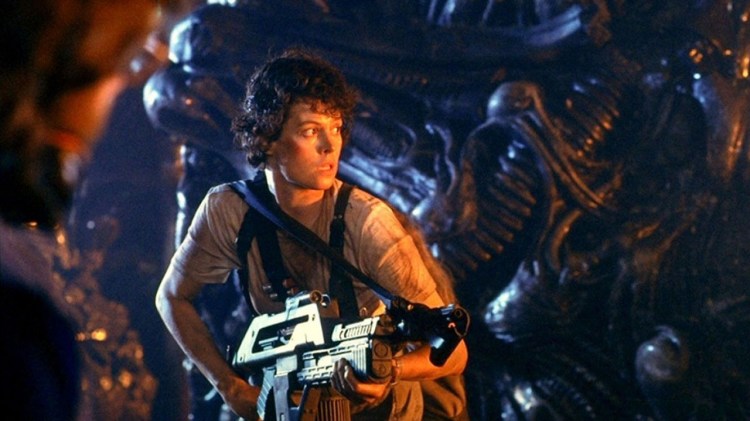
In the mid-1980s, James Cameron was just beginning to establish himself as a leading figure in Hollywood. Fresh off the success of his low-budget film The Terminator, Cameron was gaining recognition for his ability to create tense, action-packed films with compelling characters. His collaborations with producers like Gale Anne Hurd and actors like Arnold Schwarzenegger were starting to pay off.
Aliens, the sequel to Ridley Scott‘s Alien, was a risky proposition. Cameron faced the daunting task of following up on a beloved film, and there were production setbacks, including a restrictive budget and a British crew sceptical of a young, untested American director. Nevertheless, Cameron’s innovative blend of science fiction and horror and his emphasis on character development and thematic depth led to a film that outshone its predecessor in many ways. Aliens was a mammoth success, winning two Academy awards, and is routinely put up as not just one of the best sci-fi films ever but also one of the best action movies.
It is often considered one of the best sequels ever made, and it played a key role in establishing Cameron’s reputation for high-stakes, high-tech action films. It also marked Cameron’s first collaboration with actress Sigourney Weaver, who earned an Oscar nomination for her performance. The film’s themes of survival and maternal instinct would echo in Cameron’s later work, especially Terminator 2: Judgment Day. Speaking of which…

2. Terminator 2: Judgment Day
After experiencing great commercial success in the 1980s and gaining a reputation for making pulsating films, Cameron had solidified his reputation as a skilled, innovative filmmaker who could deliver visually stunning, technically complex films that also resonated emotionally with audiences. In the early 90s, Cameron decided to revisit the universe of his breakout hit, The Terminator.
Terminator 2: Judgment Day was fraught with challenges, from its massive budget (one of the highest at the time) to the groundbreaking visual effects needed to bring the liquid-metal T-1000 to life. Yet Cameron’s vision and determination paid off. The film was a box office smash, earning over $500 million worldwide, and it received critical acclaim for its cutting-edge special effects, thrilling action sequences, and thoughtful exploration of themes like destiny and morality. The film holds a 93% rating on Rotten Tomatoes.
Terminator 2: Judgment Day is widely regarded as Cameron’s masterstroke, a film that perfectly encapsulates his strengths as a filmmaker; It set a new standard for special effects in cinema. Cameron’s subsequent films would continue to push the boundaries of what was technically and narratively possible in cinema. While Cameron has helped produce The Terminator’s subsequent films, this was the last one he directed.

3. The Terminator
However, before he could make arguably the greatest sequel ever made, Cameron had to get the funds to make the Terminator film. In the early 1980s, James Cameron was a relative newcomer to Hollywood. After working as an art director on Roger Corman’s Battle Beyond the Stars and directing the sequel to Piranha, Cameron got his big break, a low-budget science fiction film that nobody expected would be a household name four decades later.
Despite a limited budget and a tight shooting schedule, The Terminator became a cult classic thanks to its innovative blend of science fiction, action, and horror. Cameron’s direction was praised for its efficiency and inventiveness, while Arnold Schwarzenegger’s portrayal of the relentless cyborg assassin became iconic. The film holds an impressive 100% rating on Rotten Tomatoes and made over $78 million worldwide against a $6.4 million budget.
The Terminator put James Cameron on the map as a promising new director with a knack for high-concept storytelling and visceral action sequences. Its success allowed Cameron to explore more ambitious projects, leading to films like Aliens and The Abyss. The film’s themes of technology and destiny would become recurring motifs in Cameron’s work.

4. Titanic
By the time James Cameron began producing Titanic in the mid-1990s, he had solidified his reputation as a leading force in the action and science fiction genres. However, this seafaring epic marked a significant departure from his previous works, focusing on a historical event and a tragic love story.
The production of Titanic was fraught with challenges, including cost overruns, a gruelling shooting schedule, and frequent clashes between Cameron and the studio. But against all odds, it became a cultural phenomenon. The film was a massive commercial success, grossing over $2 billion worldwide, and won 11 Academy Awards, including Best Picture and Best Director for Cameron. Despite some criticisms about its dialogue and plot, audiences loved the film, it wasn’t necessarily Casablanca, but it was a film that connected with people and continues to be cited as many fans’ favourite film.
Titanic marked a significant point in Cameron’s career, demonstrating his ability to craft emotionally resonant stories on a grand scale. The film’s technical achievements, particularly its realistic depiction of the ship’s sinking, further cemented Cameron’s reputation as a pioneer in using special effects. However, this wasn’t Cameron’s first nautical adventure.

5. The Abyss
After the success of The Terminator and Aliens, Cameron was given the opportunity to pursue a passion project. The result was The Abyss, a film that combined his love for deep-sea exploration with his knack for high-stakes storytelling.
It was a notoriously difficult production, with the underwater shooting proving particularly challenging. Despite these hurdles, the film was met with a positive response upon release. Critics praised its groundbreaking special effects, especially the fluid alien creature and its intense, claustrophobic atmosphere. While not as highly regarded as the projects Cameron worked on before and after, it was still well-received. The film holds an 89% rating on Rotten Tomatoes and won an Academy Award for Best Visual Effects.
It may not have been as commercially successful as Cameron’s other films, but it remains a noteworthy entry in his filmography for its technical innovation and thematic exploration of humanity’s relationship with the unknown. This theme would continue in Cameron’s later works, particularly his groundbreaking 3D film “Avatar.” Speaking of which…
6. Avatar: The Way of Water
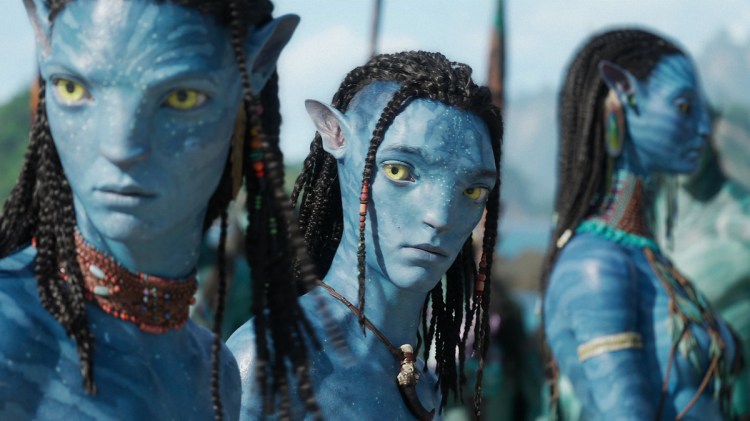
Over a decade after the release of the first Avatar, Cameron returned to the world of Pandora with Avatar: The Way of Water. At this point in his career, Cameron had solidified his reputation as a director who pushed the boundaries of filmmaking technology.
The production of Avatar: The Way of Water was ambitious. Cameron and his team developed new filming techniques and technology to capture the underwater environments of Pandora. The film is a visual spectacle featuring Cameronesque innovative technology, it’s one of the great cinematic extravaganzas of the 21st century, yet its plot was a bit predictable, and its character development was a bit sterile. The film holds a 76% rating on Rotten Tomatoes.
Avatar: The Way of Water further showcased Cameron’s commitment to pushing the boundaries of cinema. It showed that despite taking over a decade to launch another project, Cameron hadn’t lost his groove, demonstrating his ability to create immersive, visually stunning worlds.
7. Avatar
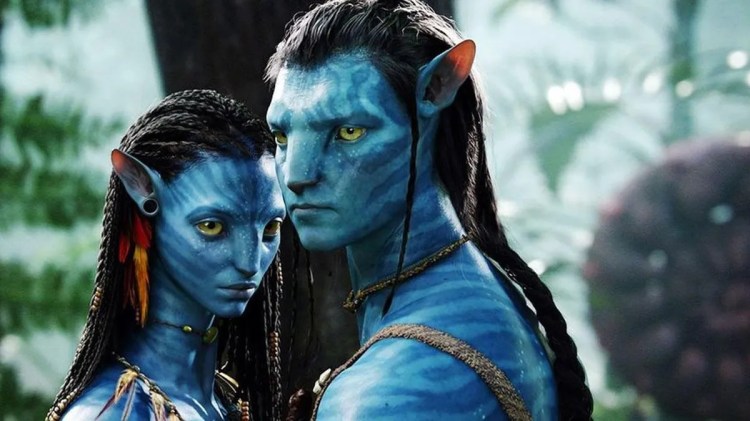
After a 12-year hiatus from feature filmmaking following Titanic, Cameron returned to the director’s chair with Avatar. It was a project that had been on his mind since the 90s, but he had to wait for technology to catch up to his vision.
Avatar was a groundbreaking film in terms of its use of 3D technology and motion-capture performances. Despite initial scepticism, the film became a global phenomenon, grossing over $2.8 billion worldwide and winning three Academy Awards. Like its sequel, critics were divided over the film’s plot and characterisation, but its visual effects and immersive world-building were universally praised. The film has an 82% rating on Rotten Tomatoes.
Avatar cemented Cameron’s place in cinematic history as a pioneer of modern 3D technology and motion-capture performance. It also marked a return to the environmental and indigenous rights themes that Cameron had touched on in earlier films like The Abyss.

8. True Lies
After the success of Terminator 2: Judgment Day, Cameron decided to explore a different genre: the action-comedy. He reunited with Arnold Schwarzenegger for True Lies, a film that marked a departure from the more serious tone of his earlier works.
It was a commercial success, blending action, comedy, and romance in a way that appealed to a broad audience. However, it lacked the tone of his best films and faced criticism for portraying Arab characters and its casual treatment of marital infidelity.
While True Lies may not be as well-regarded as some of Cameron’s other films, it demonstrated his versatility as a director and his ability to blend genres effectively. It was also one of his lighter films, offering a respite before the more serious and ambitious projects that were to come.

9. Piranha II: The Spawning
Piranha II: The Spawning was James Cameron’s directorial debut. It was a low-budget sequel that provided Cameron with his first opportunity to helm a feature film. It was the sequel to Joe Dante’s 1978 film Piranha.
Piranha II was a troubled production, with Cameron clashing with the producers and eventually being fired. Despite this, he was still credited as the director. Critics panned the film, and it has a 6% rating on Rotten Tomatoes. However, it did earn a cult following for its B-movie charm, over-the-top premise and Cameron’s subsequent success.
Despite its poor reception, Piranha II was a crucial stepping stone in Cameron’s career. During the production of this film, he reportedly conceived the idea for The Terminator, the film that would launch his career in earnest. Piranha II may be the worst film he ever made, but if we got The Terminator out of it, I say it’s worth it.
James Cameron’s Best Films
There are things which can be complained about regarding James Cameron’s filmography. His films are often formulaic, the dialogue isn’t the strongest, and his works usually lack subtlety.
However, you can’t argue with the results. Cameron has directed at least 3 – all-time great films and has a plethora of other films. He might not be the most prolific director, but each release is an event. According to my math, he is the 77th-best director of all time.
Alongside the films ranked above, Cameron has also directed two documentaries about oceanography, one about the Titanic, Ghosts of the Abyss, and the other about the ocean floor, Aliens of the Deep. Neither is amazing (Ghosts would rank 8th on this list, and Aliens of the Deep would rank just above Piranha II.
Although Cameron is getting older, he isn’t slowing down and currently plans to make an Avatar 3, 4 and 5. We don’t know what these films will be like, but you can rest assured they’ll be grandiose, visually splendid and probably be great popcorn flicks.
 Bronze Screen Dream