
Cars roarings out across the night – death-defying stunts to get a loaf of bread – Something’s in the bushes! – You know, I have no idea what it is about post-apocalypse films that grip me. Is it that sense of modern unease, the idea that we all know we’re but a click away from armageddon, or is it just the natural extreme of the man vs nature film, or more often, man vs man?
Whatever way you chalk it up, you’ll never get me to watch a film faster than if you tell me you saw a post-apocalypse film. Now, these films are very rarely worth seeing; let’s get that out of the way. They almost always have their huge gaping flaws, and pound-for-pound, they’re probably the most hit-and-miss genre; If I had to guess why I’d presume it’s because these films are made as genre pieces to cash in on trends.
I’ve seen them all, well, obviously not all of them, but I’d say I’ve seen more than most. Whether that be a low-budget non-apocalypse, This Is Not a Test or a real schlock slog like Time Barrier, I’ve been there and done that.
Hell, I’ve even liked a lot of films people disparage, like Waterworld or The Postman. I think Kevin Costner would agree with me; there’s something to peering into an apocalyptic future where man is stripped of his accessories and forced into a primitive communal state.
Costner, wouldn’t be the first Hollywood star associated with the genre; fortunately for him, his career has succeeded despite this association.
A long time ago, I watched a film called Leave Her To Heaven by John Stahl; you might’ve seen it; Scorsese loves it. It’s a classic film noir, and there’s really nothing to dislike. Dare I say it’s the best noir ever? Honestly, I prefer Laura; there’s something to Gene Tierney. The film ‘stars’ Cornel Wilde, an almost-star in Hollywood who appeared in a few major films, High Sierra, The Big Combo, The Greatest Show on Earth, but never really broke through into the upper echelon. Wilde didn’t particularly stand out in Leave Her To Heaven, it’s Tierney’s film, but for some reason, his name stuck with me.
So when I discovered he turned to direction as he got older, I was intrigued. I went to his filmography and rubbed my hands in delight; what goodies have we here? The Naked Prey? Sounds good, thrilling! It’s got good reviews; I think I’ve even seen this cover before. Yes, I think The Naked Prey will be the perfect film for me to watch, yet like Gerard Pique, I let my eyes drift and made the first mistake.
No Blade of Grass (1970)

The poster looks odd; It’s got a cool bike. I wonder what it’s about. Oh no! It’s another post-apocalypse film, this time about a virus. So as you can guess, I didn’t watch The Naked Prey that night.
So what’s No Blade of Grass about? As with any apocalypse film, that doesn’t matter, but I’ll tell you anyway. A new virus has emerged in the world; where it comes from no one knows, but it’s causing a little panic; apparently, the Chinese have firebombed their cities to stop the spread, the little panic in London starts to grow as there are rumours that the Brits also plan to firebomb their cities. Good old architect John decides to flee with his family and friends; along the way, the world around them slowly descends to anarchy, and our characters do too.
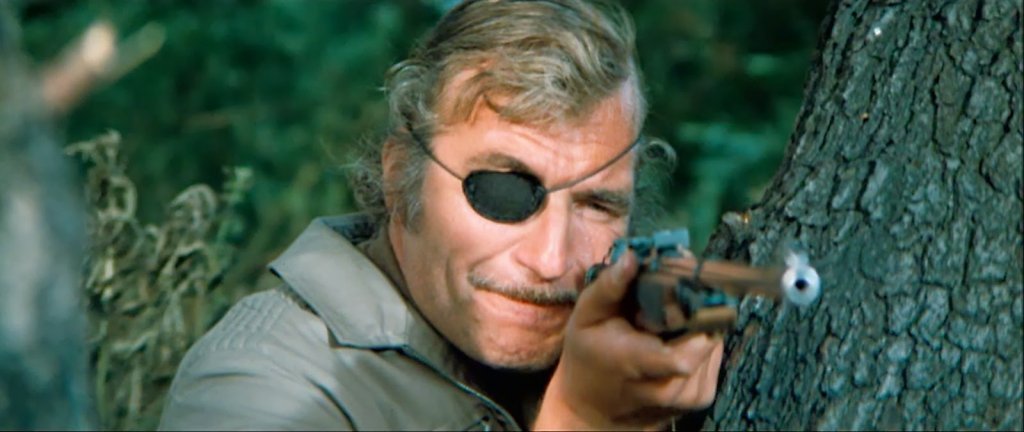
Before we dive too deep, it needs to be said that I’ve never seen a one-eyed, eyed-patch-wearing veteran architect, and I’m still not convinced I’ve seen one, as Nigel Davenport is about as one-note as it comes. He’s as unbelievable as he is unsympathetic, which makes the movie hard to swallow, so you end up watching it from afar, not judging the characters’ decline but rather apathetically watching it.
No Blade of Grass has an interesting premise, and it’s ahead of its time, but it’s aimless and preachy. Yes, we should take care of our environment, and if they’d heeded this film, we’d be in a better place, but its heavy-handedness is more laughable than touching. Besides, there is something off about watching a film from decades ago warning us about looking after the environment, a sort of naive generational hypocrisy.
I could get further into the plot, but why bother? It’s rather ploddy and aimless, and it’s very apocalypse-by-numbers. It’s never really charming, but the moody atmosphere is enjoyable.
The most interesting thing to me is why on earth Wilde ended up directing this. I’ve been unable to find an easy answer to this by googling ferociously, so we have to rely on assumptions. Wilde was probably drawn to the ecological themes and all that and probably had the best intentions. Still, if you keep a drawer filled with post-apocalypse films, you can proudly open it, drift past The Quiet Earth, Miracle Mile and The Corbin Project, and place it right next to Quintet and Virus.
Yet! – That’s right, there’s something else –
Panic in Year Zero! (1962)

Wilde wasn’t the only post-stardom post-apocalypse director, as there was one before him. Eight years before No Blade of Grass, there was a small, low-budget AIP film called Panic in Year Zero!
Panic in Year Zero! was another post-apocalypse film, this time about the aftermath of nuclear war, which is ever so slightly more interesting than viruses possibly from China; we’ve done that already. Panic in Year Zero is about a family on their fishing trip hearing an explosion and realising the countries under attack; as the rest of America scratches their chin and slowly hears about the attack Harry Baldwin, the father, takes advantage of their head start and prepares for the worst.
After robbing a gun store and buying provisions, the family ends up in a cave, where they live and settle into a rhythm before coming into conflict with a gang of youths – damn kids, why can’t they be more like Frankie Avalon! Something else happens, the end!
Panic in Year Zero! Starred Academy Award winner Ray Milland, who you might recognise from films like The Lost Weekend or Dial M for Murder; Milland wasn’t like Wilde, a fringe star, but like Wilde, his celebrity did fade, and we can presume so did his bank account as he ended up taking several AIP jobs, such as the good Roger Corman film, X: The Man with the X-Ray Eyes.
Milland didn’t just star in the film; he also directed it, thus the link with Wilde. Milland had directed a few films before this, like A Man Alone, a pretty good little western. But unlike Wilde, he didn’t seem to have the knack for directing, as while Wilde had The Naked Prey, Milland had this.
I liked Panic in Year Zero! It was quaint; I liked the feel of it. I enjoyed the early 1960s take on apocalypse, the cynicism of the lead. I actually really enjoyed this. The film’s first half is impressive and vital, as they dash around, slowly coming to terms with the end of the world as they know it and realising that the family must do what they can to survive. The second half is melodramatic and stagey and has a stupidly optimistic ending. It’s definitely prescient and ahead of its time. When you compare it to other early 60s post-apocalypse films like This Is Not a Test or The Creation of the Humanoids, you get that Milland understands what the appeal of these films is; it’s the urgent action in the face of damnation, not the talking about it.
So should you watch Panic in Year Zero!? Yes, if you like AIP films, post-apocalypse oldies and getting a small glimpse of what could have happened. Yet, its stagey presence towards the end is tiring, and the film stops feeling so dynamic the more it goes on. It’s better than No Blade of Grass, but No Blade of Grass is much more cynical in the long run and doesn’t offer us a palatable conclusion.
Just like this.
 Bronze Screen Dream